GongBan AI Team | Shenzhen | About an 8-minute read
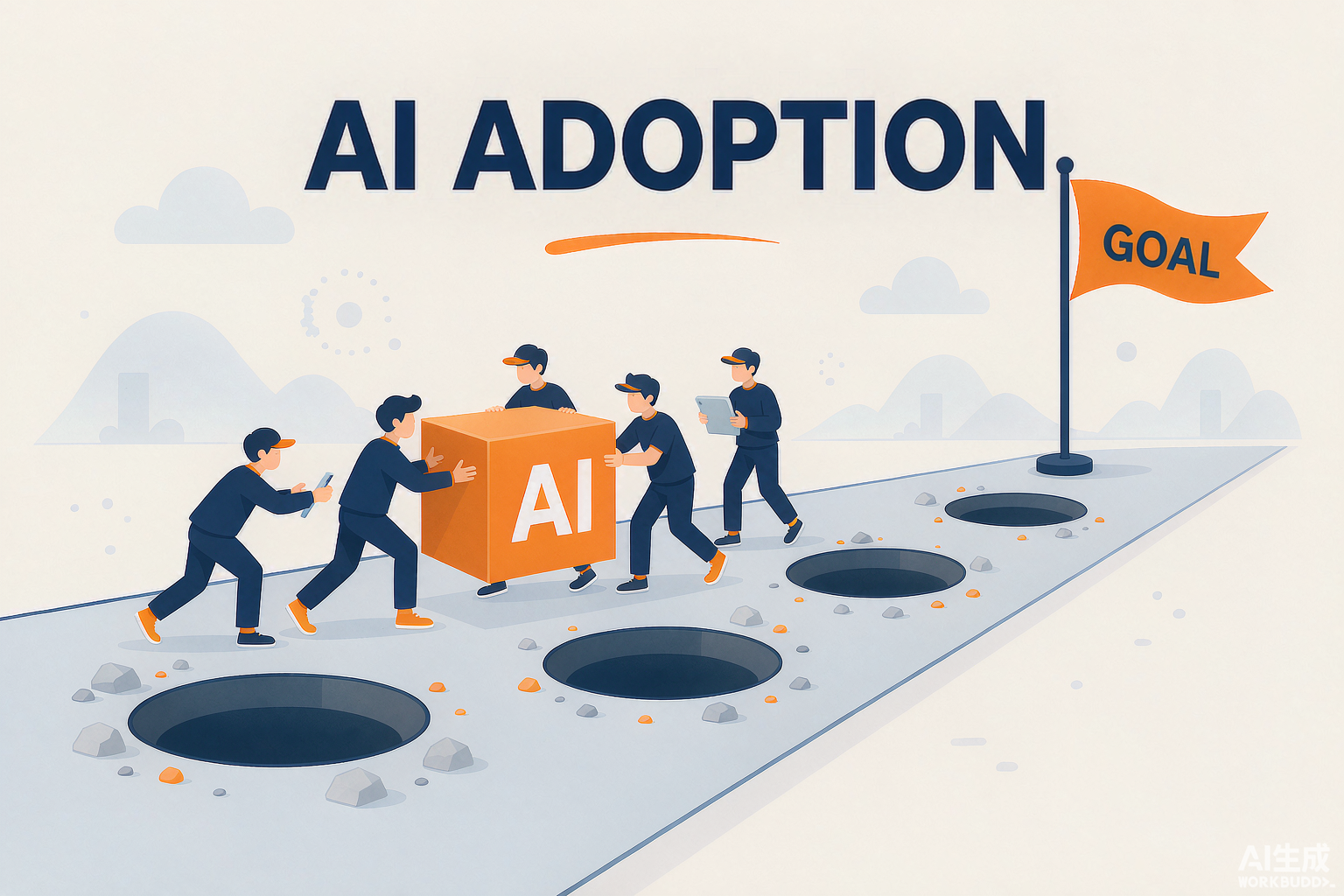
When enterprise AI initiatives fail, most do not fail on model capability — they fail on ten specific organizational issues: from choosing the wrong use case and skipping acceptance criteria to mismatched budgets and refusing to cut losses. GongBan AI has delivered more than twenty enterprise AI projects; this article lays out every pitfall we have seen, each with a countermeasure and a way to self-check.
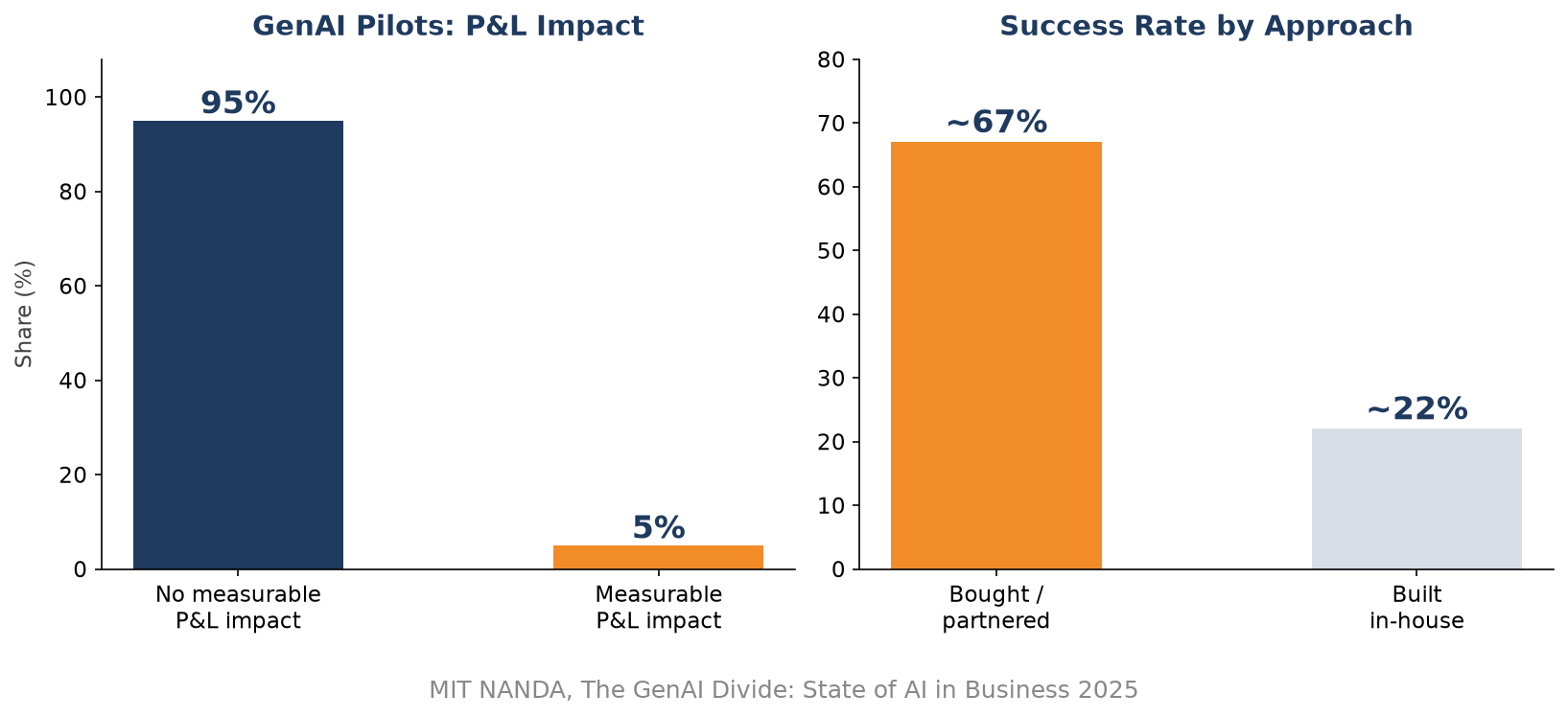
First, the industry backdrop: the MIT NANDA project's 2025 report The GenAI Divide found that about 95% of enterprise generative AI deployments produced no measurable P&L impact. To be precise, this is not "95% of projects failed" — rather, a universal gap sits between pilots, launches, and business value. Our own project retrospectives align closely with that conclusion: companies that fall into the gap stumble in different ways, but the causes overlap heavily.
Pitfall 1: Starting from Tools, Not Use Cases
The one-sentence answer: ask "which AI should we buy" first and you will buy wrong; ask "which task consumes the most manpower" first and you might buy right.
The most familiar scene: the boss returns from an AI summit, buys a pile of tools, then asks "who wants to try them out?" The right order is reversed — list the tasks that consume manpower every day, score them on frequency, time cost, and rule clarity, pick the highest-scoring use case, and only then find a tool that fits it.
Self-check: if you cannot say "which task for which role saves how many minutes with AI," you have stepped on this pitfall.
Pitfall 2: Training Before Use Cases — the Implementation Gap
The one-sentence answer: training produces awareness, but business results come from applicability — data, process, and ownership sit in between. Leave the gap unclosed and the more you train, the wider the results fall behind.
We have watched too many companies turn AI adoption into two all-hands lectures: everyone is excited in the room, and back at their desks the next day the tool is never opened again. The countermeasure is to pick one concrete scenario first (say, "payroll calculation takes 4 hours"), deliver targeted training around it, and let trainees watch their own task get faster before class ends — after one of our manufacturing clients did this, the same team cut that calculation from 4 hours to 5 minutes (represents that project only).
Pitfall 3: Rolling Out to Everyone Without a Pilot
The one-sentence answer: company-wide rollout without a reference implementation means amplifying an unproven question across the whole company.
The right move is to prove one quantifiable pilot in one department first, gather the evidence that "our process works with this," then replicate horizontally. A retail chain brand that needed differentiated content for 2,000+ stores also proved a regional pilot before scaling (represents that project only). All-hands meetings are for mobilization, not validation.
Pitfall 4: Making IT the Project Owner
The one-sentence answer: AI adoption is business transformation, not an IT project — without a business owner in charge, nothing moves.
IT can answer "can it run" but not "should it run, and what counts as success." Countermeasure: the business owner leads, IT supports; acceptance metrics are written in business terms (hours saved, error rate, response time), not system uptime.
Pitfall 5: No Acceptance Metrics
The one-sentence answer: an AI project without metrics will report nothing but "it feels faster" three months later.
Agree before launch: current time cost, target time cost, and the error-rate ceiling. Self-check: ask three project participants how long the task took before and after — if the three answers disagree, the metrics were never set.
Pitfall 6: Budgets Spent in the Wrong Place
The one-sentence answer: over half of budgets go to sales and marketing AI tools, but both the research and our delivery experience point to back-office automation as the ROI highland.
The MIT report also found: companies put more than half of their generative AI budgets into sales and marketing tools, while the highest-return applications are back-office automation — replacing process outsourcing and compressing external agency costs. In our own delivery, the projects with provable ROI are mostly in "unsexy" back-office scenarios: report calculations, document processing, paperwork generation.
Pitfall 7: Insisting on Building In-House Instead of Buying
The one-sentence answer: MIT's data shows purchased vendor solutions succeed about 67% of the time; in-house builds succeed at roughly one-third of that rate.
Many companies default to "building it ourselves is safer and more controllable," then spend a year still pouring the foundation. Countermeasure: for non-core capabilities, buy or partner first; reserve in-house development for what truly forms a moat. This is not absolute — scenarios with extreme data-compliance requirements are another matter — but "build" should be a decision made after evaluation, not a reflex.
Pitfall 8: Unclear Data Boundaries
The one-sentence answer: employees hesitate to hand real work to AI mostly because the company never said which data AI may touch.
This is the most overlooked pitfall: the technology works, but nobody dares use it — can client data go into the tool? Can local files be authorized? Countermeasure: before rollout, define data classification, tool permissions, and audit methods, and choose an enterprise edition with org management and data isolation. Clear rules are what make employees actually use it.
Pitfall 9: Treating "Bought the Tool" as "Finished the Adoption"
The one-sentence answer: tool delivery is not adoption; organizational readiness is the bulk of the work.
The MIT report names the core problem the "learning gap" — general tools do not adapt themselves to your workflow, and organizations do not automatically learn to use them. Countermeasure: write process redesign, permission configuration, skill solidification (turning repeated operations into reusable templates), and staff training into the project plan, and leave room for a "run two weeks, then adjust" window.
Pitfall 10: No Results in Six Months, Yet Refusing to Cut Losses
The one-sentence answer: an AI project with no metric movement after six months probably picked the wrong use case — cutting losses matters more than pushing harder.
Our rule of thumb: single-point scenarios show quantifiable change in 2–4 weeks; cross-department processes in 2–3 months. Double that with nothing to show, suspect the use case first, execution second, the tool last.
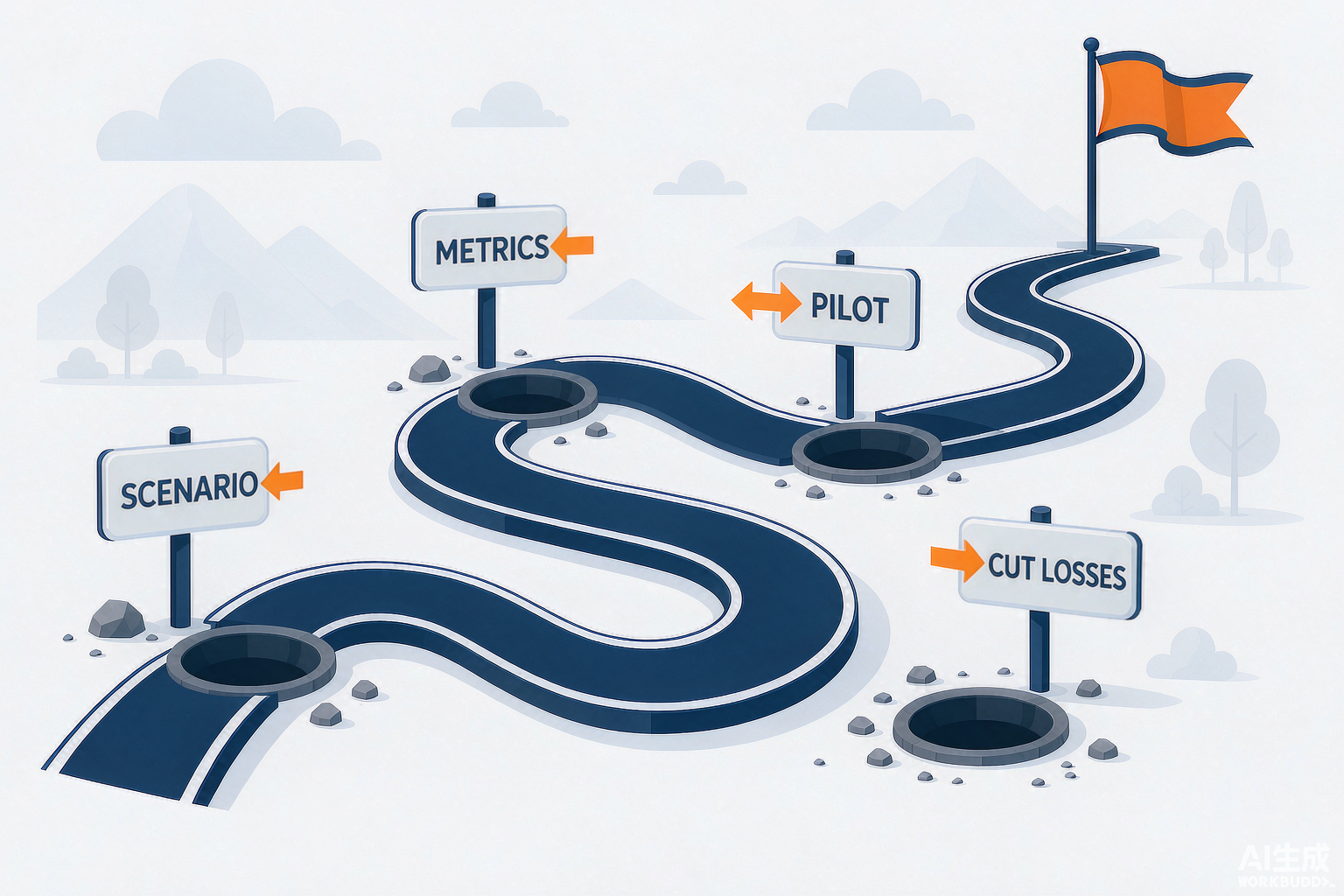
A One-Page Self-Check Table
| # | Pitfall | One-Line Self-Check |
|---|---|---|
| 1 | Tools first | Can you name which task saves how many minutes? |
| 2 | Training before use case | Was training built around a concrete scenario? |
| 3 | Rollout without a pilot | Is there a proven pilot department? |
| 4 | IT as owner | Is a business owner leading? |
| 5 | No metrics | Can you state time cost before and after? |
| 6 | Mismatched budget | Is the money on back office or on demos? |
| 7 | Build in-house by default | Was in-house an evaluated choice or a default? |
| 8 | Data boundaries | Do employees know what they may hand to AI? |
| 9 | Tool purchase = adoption | Is organizational readiness in the plan? |
| 10 | Refusing to cut losses | Six months in — have the metrics moved? |
Enterprise AI adoption is like irrigation: the pipe (the tool) is only one part. Miss the water source (data), the field (use case), or the person managing the water (the owner), and nothing reaches the crops. The ten pitfalls, at their core, are all about completing everything beyond the pipe.
Failed companies fail in their own ways; successful ones all win on the same twelve words: start from business pain, accept the results with metrics. To find out where your company is stuck, book a free enterprise AI diagnosis from GongBan AI.
Further Reading
- The First Step in Enterprise AI: Choosing the Right Use Case (with a Four-Step Method)
- The Five-Step WorkBuddy Enterprise Rollout: From Subscription to Real Usage
References
- MIT NANDA, The GenAI Divide: State of AI in Business 2025, as reported by Fortune (including "~95% of pilots show no measurable P&L impact," "~67% success rate for external purchases," "over half of budgets go to sales and marketing"), 2025-08-18, https://fortune.com/2025/08/18/mit-report-95-percent-generative-ai-pilots-at-companies-failing-cfo/
- GongBan AI, "The First Step in Enterprise AI: Choosing the Right Use Case", 2026-09-12, https://www.gongbanai.com/en/article/ai-landing-scenario-first.html
- GongBan AI case studies: a traditional manufacturer, a light-beauty retail chain (data represents the respective projects only)