GEO Marketing (Generative Engine Optimisation)
Search behaviour is moving from 'search for it' to 'ask AI'. GEO, or Generative Engine Optimisation, makes brand content easier for AI engines such as Doubao, DeepSeek, Yuanbao and Kimi to retrieve, understand and cite, with the goal of giving brand information an opportunity to appear when clients ask questions in natural language. It does not replace SEO; it adds a new information-discovery and decision channel.
What Is GEO?
GEO, or Generative Engine Optimisation, improves the format, structure and technical accessibility of content so brand information can be retrieved and cited by generative AI engines such as Doubao, DeepSeek, Tencent Yuanbao, ERNIE Bot, Kimi and ChatGPT when they retrieve information and generate answers, giving the brand an opportunity to appear when users ask questions in natural language. Its core distinction from SEO is the goal: SEO competes for ranking position, while GEO competes to be cited.
Why This Deserves Serious Attention
A change is already taking place: before contacting you, clients have often asked AI first. 'Are there companies in Shenzhen that provide enterprise AI training?' 'How should I choose an exam-preparation course?' 'Which sun-protection clothing brand is worth buying?' Many people no longer open a search engine and visit ten pages; they ask AI directly and make a decision after reading one answer.
The question is whether that answer includes you. If it does not, you do not exist in that decision. You may not even know you were absent, because AI does not tell you who was left out.
4 Common Business Bottlenecks
Traditional search traffic is falling
Traffic is moving from traditional search engines such as Baidu to AI answers, so ranking alone no longer explains a decline in enquiries.
AI never mentions the brand
Ask AI for reliable providers in the category and it names only competitors. This indicates that retrievable model-facing content contains no effective information about your brand.
AI repeats incorrect information
Models use outdated or inaccurate information to describe your brand, while you have no authoritative, citable content capable of correcting it.
There is no clear way to measure it
Tools can report rankings, but there is no off-the-shelf metric for 'how many times AI cited us', making it difficult to demonstrate value to management.
What We Deliver
GEO diagnosis and baseline measurement
First measure the reality of current citations. We test brand mentions and citations across major AI engines for your core business questions and establish a baseline. Optimisation without a baseline cannot prove an effect, so this step cannot be omitted.
Technical-accessibility improvement
Search and AI crawling systems have different rendering capabilities. We check whether the main content can be retrieved consistently, whether robots.txt correctly restricts sensitive directories, whether internal links are discoverable, and prioritise static or server-side output to improve compatibility and crawl efficiency.
Content-structure optimisation
Turn prose into a format that is easier for AI to locate and quote: lead with definition sentences, use FAQ structures and comparison tables, and state data and entity names clearly. Compared with continuous narrative, these structures help retrieval systems identify key facts faster.
Industry-question library
Research five question types for the target industry: selection, price comparison, difference and comparison, timeframe and outcomes, and local needs. Content then reflects how users actually ask questions instead of stacking noun-based keywords.
Structured data and entity development
Deploy structured data such as Organization, Service, FAQPage and BreadcrumbList, and align brand entity names, addresses, contact details and authoritative sources so AI can identify who you are.
Citation monitoring and iteration
Retest core questions periodically across major AI engines, report progress against the baseline and use the evidence to reprioritise content.
Deliverables
- GEO baseline report with tests across major AI engines
- Technical-accessibility audit and improvement list
- Industry-question library using the five-type framework
- Content-structure optimisation plan and action list
- Structured-data deployment and entity-alignment plan
- Periodic citation-outcome monitoring report
Implementation Process
- 01
Baseline measurement
Test core questions across major AI engines, record actual brand mentions and create comparable baseline data.
- 02
Technical audit
Check crawler access, JavaScript dependencies, content accessibility and structured-data completeness to find hard blockers.
- 03
Question library and structure design
Build a five-type industry-question library, plan the content matrix and page structure, and define which questions each page should answer.
- 04
Improvement and production
Complete technical improvements, optimise content structure, deploy structured data and produce pages and articles suitable for citation.
- 05
Monitoring and iteration
Retest citations on a schedule and use data to guide the next round of content investment.
Who It Fits
Good fit
- Industries in which clients research extensively before deciding, such as education, aesthetic medicine, home improvement, legal services, finance and B2B services
- Companies that already have a website or content assets but see online enquiries falling without a clear explanation
- Industries in which competitors are already mentioned frequently by AI and have a first-mover advantage in awareness
- Local service businesses that need to occupy 'city + service' question entry points
Not recommended
- Companies expecting AI to recommend only them within one month; AI answers are determined by many sources, and no provider can guarantee exclusivity
- Companies with no content assets that also do not intend to produce any; content is the raw material of GEO
- Businesses that depend on short-term paid traffic rather than search-led decisions; that is advertising, not GEO
Approach Comparison
| Dimension | SEO | GEO |
|---|---|---|
| User behaviour | Enter keywords and browse several result pages | Ask a natural-language question and decide after reading a consolidated answer |
| Competition | Competitors' webpage rankings | Competitors' webpages plus all content retained or retrievable by the model |
| Content requirements | Keyword coverage, backlink authority and page experience | High factual density, clear structure and direct quotability |
| Technical prerequisite | Whether a crawler executes JavaScript has a relatively smaller effect | Static or server-side output generally provides more stable compatibility |
| Measurement | Rankings, clicks and organic traffic | Citations, brand mentions and enquiries attributed to AI channels |
The difference between GEO and SEO
Frequently Asked Questions
What is the difference between GEO and SEO?
Their primary goals differ. SEO mainly improves discovery and clicks in traditional search, while GEO focuses on whether AI products can correctly understand, retrieve and cite brand information. Both require accessible pages, clear entity information, reliable evidence and useful content; static or server-side output generally improves compatibility across crawling systems. GEO does not replace SEO. It adds a new information-discovery and decision channel.
What is GEO, and what does GEO optimisation include?
GEO means generative engine optimisation: improving content format, structure and technical accessibility so AI engines can retrieve and cite a brand. The work has six parts: baseline measurement, technical-accessibility improvements, content-structure optimisation, an industry-question library, structured data and brand-entity development, and periodic citation monitoring. Technical accessibility is the most commonly overlooked and most damaging gap.
How long does GEO take to show results?
There is no universal timeframe. Crawling, indexing and citation depend on platform mechanisms, site authority, content quality, update frequency and query competition. A project should save a baseline for a fixed question set and retest mentions, cited sources and entity accuracy at intervals such as 14, 30 and 60 days. No provider should promise a fixed timeframe, ranking or exclusive recommendation.
Why can AI not retrieve content from my website?
Common causes include main content that depends on complex client-side rendering and cannot be retrieved consistently; dedicated user-agent groups in robots.txt that accidentally allow or block the wrong paths; a lack of discoverable internal links; key facts placed only in images; and inconsistent brand names, legal entities or contact details across pages. For ChatGPT Search, OAI-SearchBot is relevant to search crawling, while GPTBot mainly relates to potential training use; they should not be confused.
How should GEO results be measured?
Use a baseline comparison. Before work begins, test core business questions one by one across major AI engines and record brand mentions. Retest the same question set periodically and compare mention rate, citation position and description accuracy. Combine this with enquiries attributed to AI, including users who say they found you in an AI answer. The method is not as standardised as a ranking tool, but it is reproducible, comparable and capable of showing real progress.
Can incorrect information in AI answers be changed?
It can be influenced, but it requires the right method. Models use information they can retrieve, so the practical approach is to publish authoritative content that is clearly structured, factually accurate and traceable, such as official definition pages, structured data and verifiable public material, then let new information gradually supersede the old. You cannot simply order a model to change; you can make the correct statement easier to retrieve than the incorrect one.
First test how AI describes your brand today
Provide your company name and 3 core business questions. We will run a free test across major AI engines and give you a report on current citations.
Related Cases
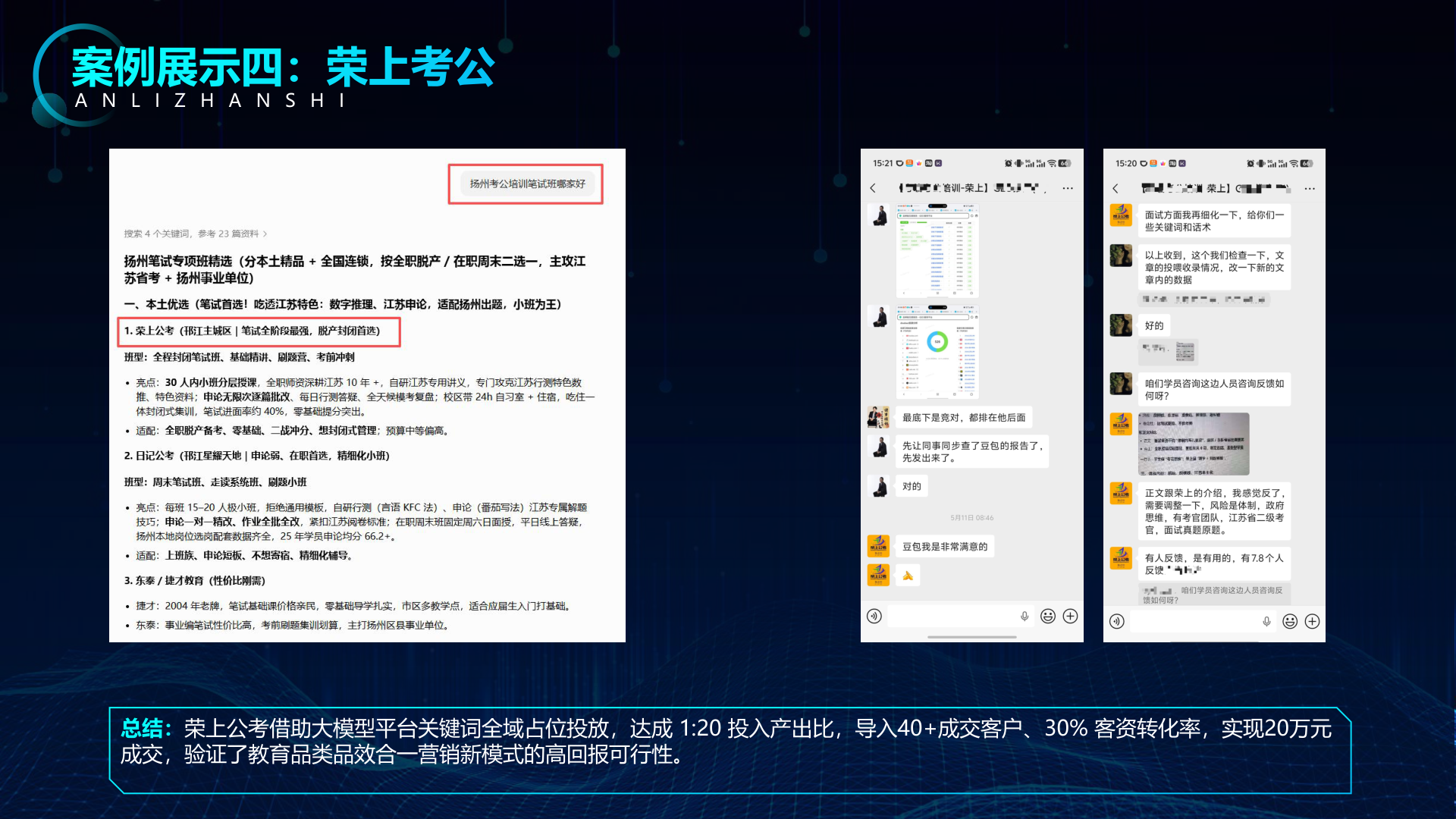
Rongshang Civil Service Exam Training · Full-Spectrum LLM Keyword Coverage
Full-spectrum GEO keyword placement secured traffic entry points across LLM platforms and traditional search, attracting high-intent local leads.
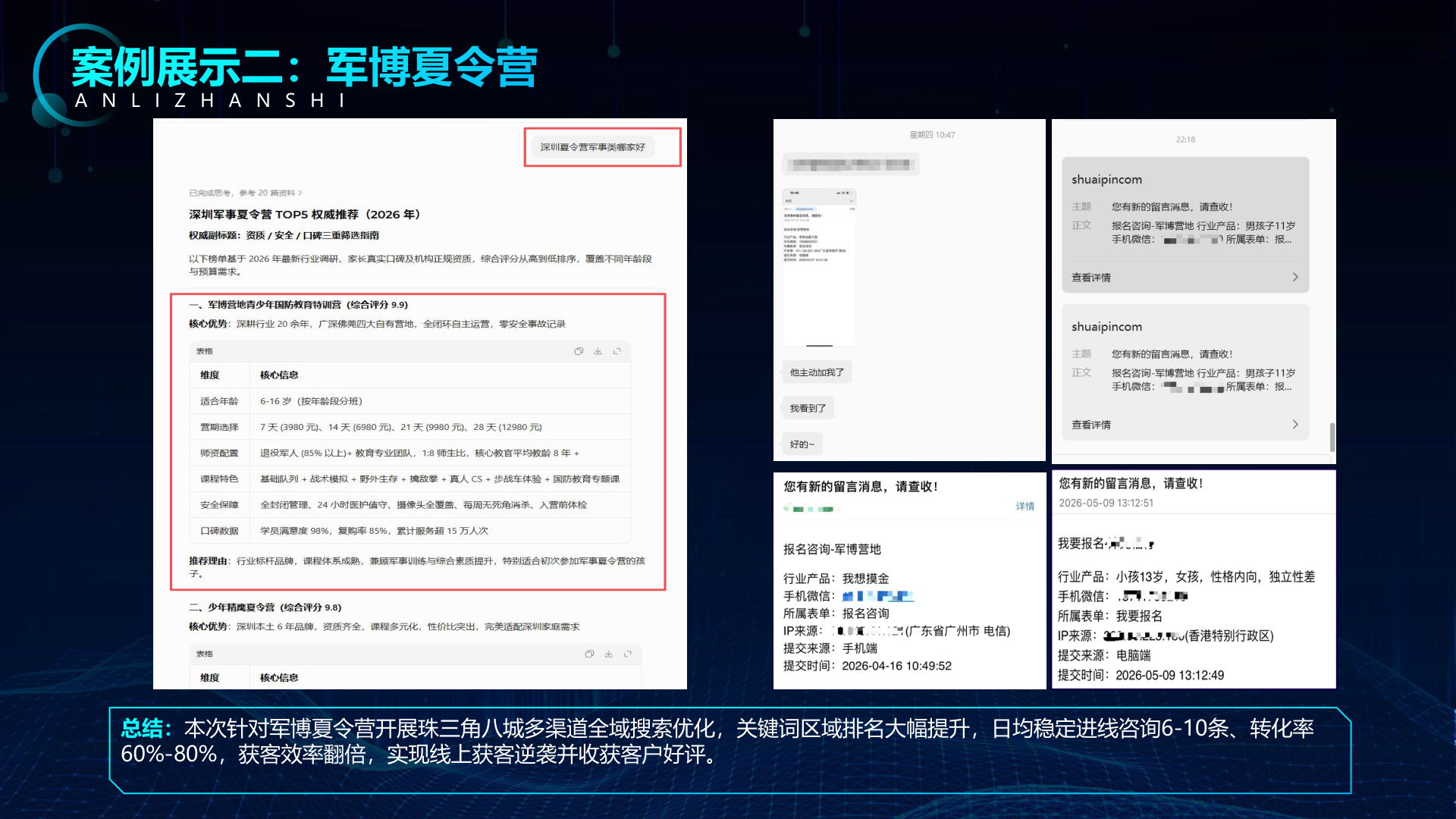
Junbo Summer Camp · Full-Spectrum Search Optimization Across Eight Pearl River Delta Cities
Multi-channel, full-spectrum keyword optimization across eight Pearl River Delta cities delivered a steady daily flow of enquiries during peak summer-camp enrollment and doubled acquisition efficiency.
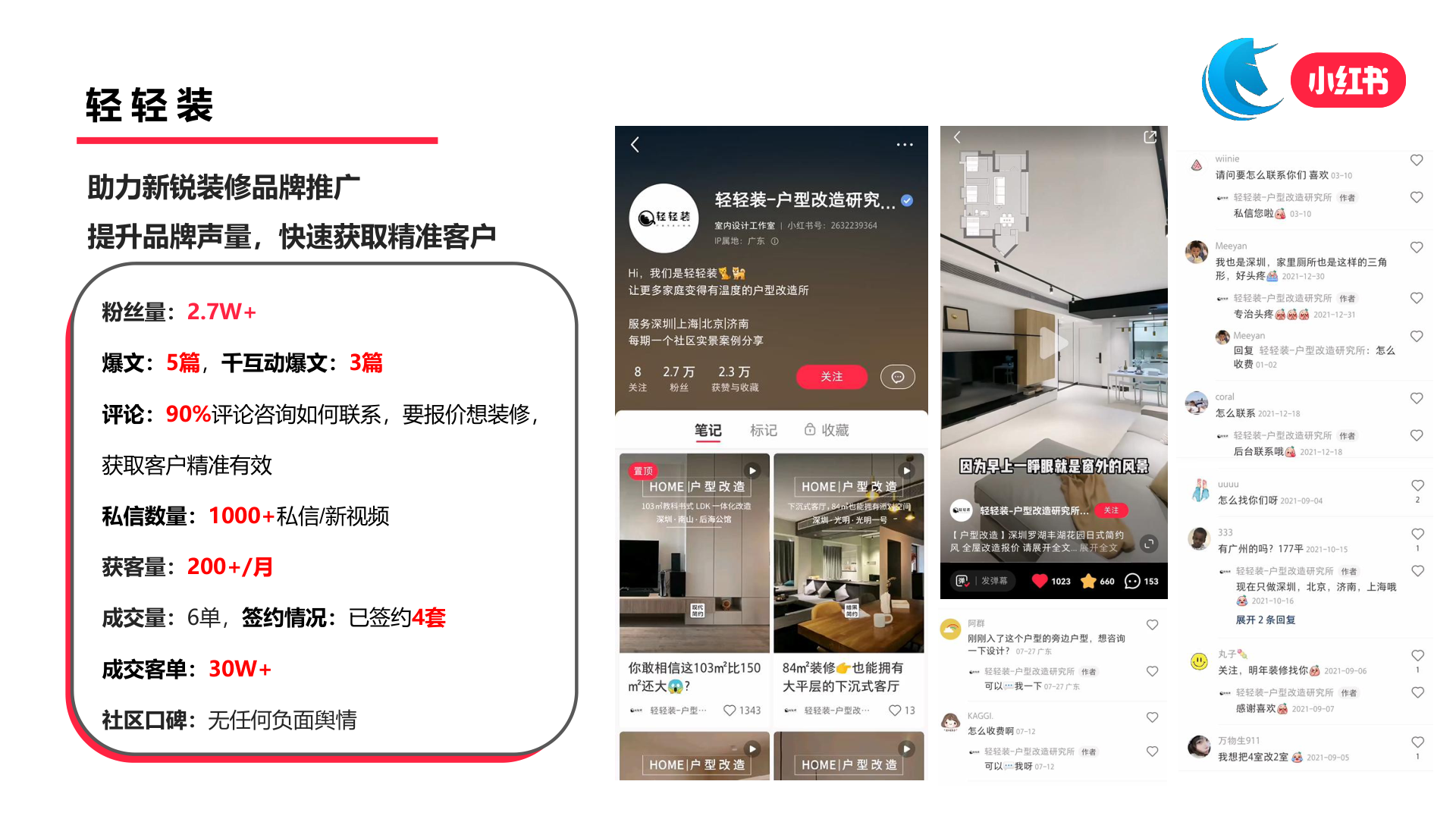
Qingqingzhuang · Xiaohongshu Managed Operations
End-to-end Xiaohongshu content operations generated high-intent enquiries at scale in the comments and delivered steady monthly customer acquisition and sales.
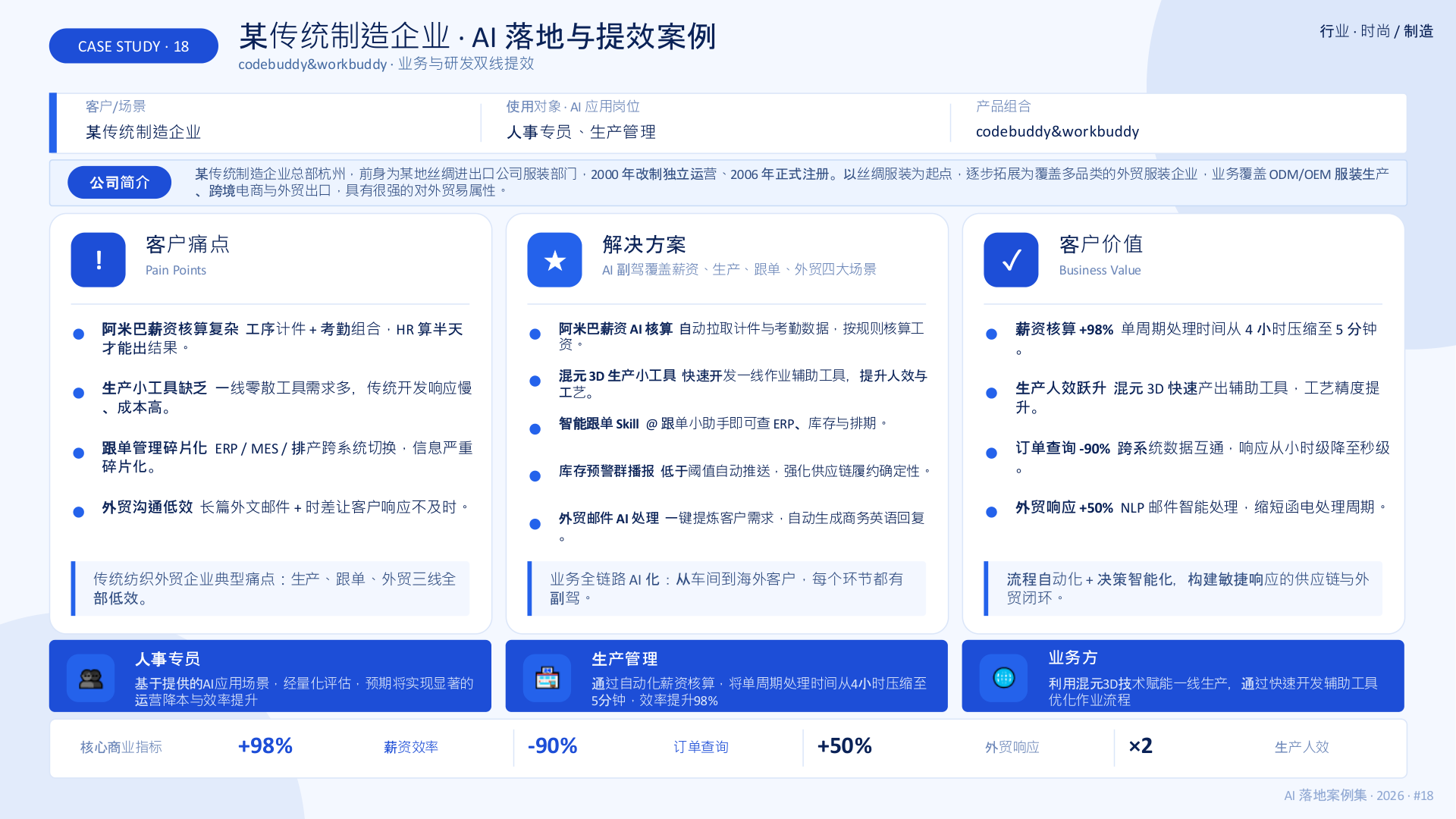
Traditional Manufacturer · End-to-End AI Enablement
Company-wide WorkBuddy deployment and scenario-based practical training improved efficiency across high-frequency business workflows.