WorkBuddy Enterprise Training and Implementation
WorkBuddy is Tencent's all-scenario AI workspace. Give it one natural-language instruction and it can break down the task, call tools, work with local files and deliver review-ready documents, spreadsheets and presentations. GongBan AI provides an end-to-end service covering selection, scenario design, company-wide training and implementation support, helping teams start on day one and put the product to work.
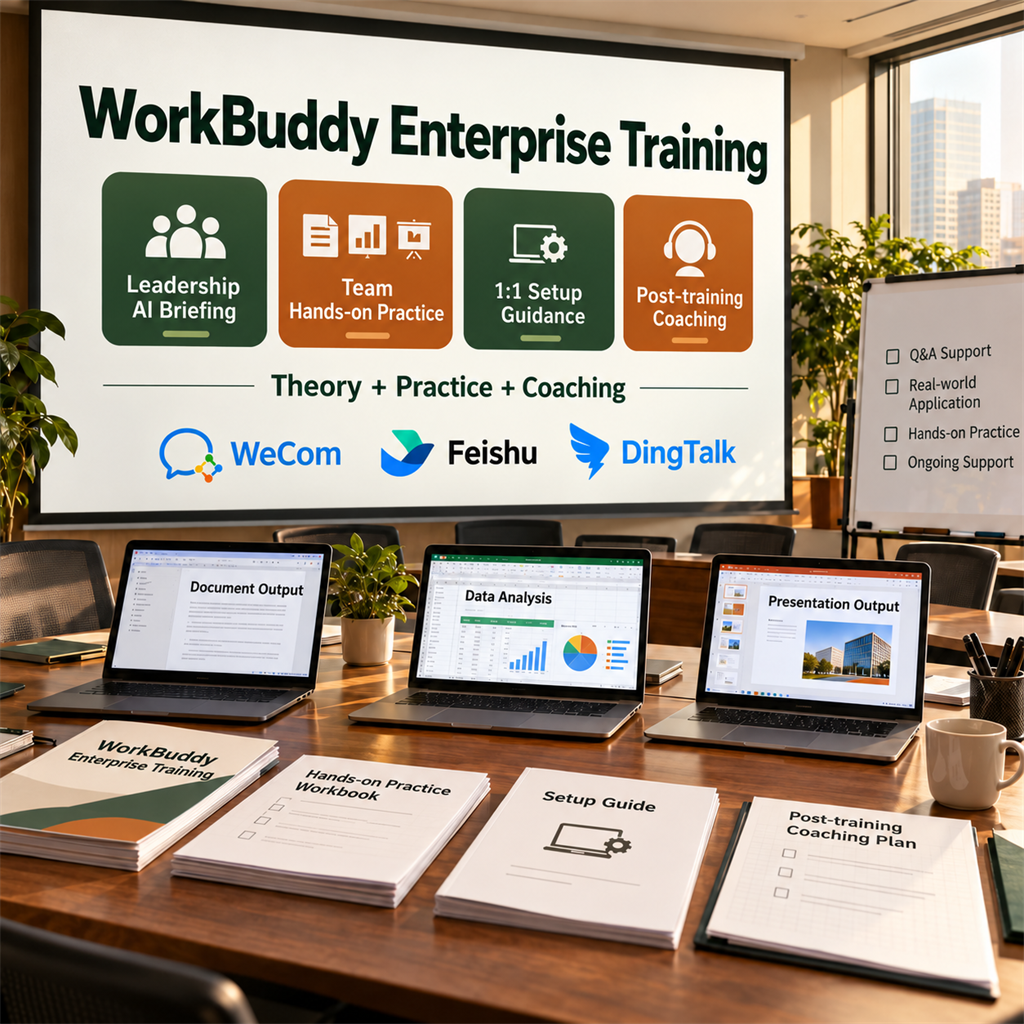
What Is WorkBuddy?
WorkBuddy (Tencent WorkBuddy) is Tencent's all-scenario AI workspace and is also described as a desktop AI-agent workspace for professionals. Its core model is simple: a user describes a need in natural language, and WorkBuddy independently breaks down the task, plans the steps, calls skills and tools, works with authorised local files and ultimately delivers ready-to-use output files such as Markdown, Word, Excel and PowerPoint, rather than only offering conversational advice. It can connect to workplace tools including Tencent Docs, Tencent Lexiang knowledge bases, Tencent Meeting, QQ Mail, ima notes, Weixin and WeCom, and it supports remote instructions to a computer through IM tools such as WeCom and Weixin.
Why This Deserves Serious Attention
Companies fail at buying AI tools with surprising frequency. The tool is often not the problem; the problem is that nobody uses it after purchase. We have seen this repeatedly during delivery: accounts are activated, the training notice is sent, and three months later the admin console shows three active users, two of whom work in IT.
Agents such as WorkBuddy that can actually carry out work need an implementation method more than most tools. Unlike a chatbot that can be used immediately after opening, it must read and write files, break down tasks and call skills that the organisation has accumulated. Someone must translate 'how the tool works' into 'which action in your role it should perform'. That translation is the core of GongBan AI's enterprise training service.
4 Common Business Bottlenecks
The tool was purchased but never adopted
Employees receive accounts, try the tool twice, decide it is faster to do the work themselves and return to the old method. The root cause is not the tool; nobody embedded it in a specific workflow.
Training is forgotten as soon as it ends
A two-hour company session without practice scenarios, a support channel or reusable templates leaves knowledge close to zero within two weeks.
Employees do not know what to use it for
Most roles contain three to five high-frequency repetitive actions, but employees often cannot identify them themselves. An external perspective is needed to map roles against tasks.
Data security creates hesitation
Can the tool read these files? Could client information leak? Can it be deployed privately? Until these questions are resolved, teams will not use it for real work.
What We Deliver
AI awareness session for management (half day)
For company leaders and senior and middle management. It explains the real boundaries of technical progress, which scenarios can be implemented now and how to calculate return on investment. The goal is to give decision-makers realistic expectations and avoid the extremes of 'AI can do everything' and 'AI is useless'.
Practical class for key users (one day)
For seed users selected from each department. Participants practise with the company's own files: drafting and rewriting documents, organising data and charts, turning meeting notes into actions and processing files in batches. Each department leaves with 3 repeatable use cases that day.
Company-wide introduction (half day)
An awareness and onboarding session for all employees, focused on helping everyone master at least one action that saves time immediately. It includes a standard operating guide and a frequently asked questions list.
Role-based scenario workshop (one to two days)
Participants work in role groups such as administration, HR, finance, sales, operations and legal. We map recurring tasks role by role, convert them on site into instructions that WorkBuddy can execute and package proven patterns as reusable skills.
Implementation support (90 days)
Training takes only two days; the remaining 88 days determine whether implementation succeeds. We provide a dedicated support coach, a question channel, monthly reviews and checks on skill reuse, turning 'learn and forget' into steadily improving use.
Deliverables
- Role × task inventory with AI-suitability priorities
- Role-based training materials and session recordings
- Company-specific prompt and skill template library
- Standard operating guide and frequently asked questions
- Implementation measurement framework, including active-use rate and task-efficiency improvement
- 90-day support review records and optimisation recommendations
Implementation Process
- 01
Needs diagnosis
Understand the business model, team size, existing tools and genuine pain points, then determine whether WorkBuddy is actually the right solution. If it is not, we will say so directly.
- 02
Scenario inventory
Review recurring tasks role by role, label them 'AI-ready / requires redesign / currently unsuitable' and create a priority list.
- 03
Programme design
Define the role-based training structure, timetable and practical materials, using the company's own files instead of demonstration data wherever possible.
- 04
Role-based training
Deliver separate sessions for management, key users and all staff. Theory, hands-on work and same-day outputs replace lecture-only training.
- 05
Support and standardisation
Provide post-training Q&A, iterate templates and conduct monthly reviews so personal techniques become organisational capability.
Who It Fits
Good fit
- Companies that have decided, or are considering, introducing AI office tools and need someone to turn a tool into productivity
- Teams of more than 50 people with a high share of repetitive documents, data processing and reporting
- Organisations that make extensive use of Tencent tools such as WeCom, Tencent Docs and Tencent Meeting
- Organisations that want to prove the approach with a seed team before expanding gradually, rather than rolling it out to the entire company at once
Not recommended
- Organisations that only want to buy accounts and do not need training or implementation support; we would recommend going directly to an official channel rather than paying us a service fee
- Organisations expecting one day of training to transform working methods completely; that is unrealistic and we will not promise it
- Projects whose primary need is custom software development or systems integration; that is a product-development service
Approach Comparison
| Platform | Core capability focus | Best suited to | Clear limitation |
|---|---|---|---|
| Tencent WorkBuddy | Local-file operations and autonomous delivery of outputs, connected to the Tencent workplace ecosystem | Teams that want AI to complete work without changing their existing office habits | Focused more on individual and team efficiency; organisation-wide knowledge capture and training systems require additional support |
| ByteDance Coze | Multi-agent orchestration and collaboration, with a broad workflow and plugin ecosystem | Technically capable teams that need to orchestrate multiple collaborating agents | A degree of complexity for non-technical users |
| Feishu Base Agents | Uses data tables as both the data source and operating interface, with deep IM and document integration | Teams whose business data is concentrated in Feishu tables and that want to avoid building a new system | Knowledge sources are relatively narrow and mainly depend on tables and documents |
| DingTalk Wukong | Native operation of thousands of DingTalk capabilities with inherited enterprise permissions | Companies deeply invested in DingTalk that need AI to operate DingTalk functions | Highly dependent on the DingTalk ecosystem and difficult to use without DingTalk |
Capability focus of WorkBuddy and major enterprise AI-agent platforms, compiled from public 2026 product information and third-party selection content for reference only
Frequently Asked Questions
What is WorkBuddy, in one sentence?
WorkBuddy is Tencent's all-scenario AI workspace. You give it a task in natural language; it breaks down the steps, calls skills and tools, works with authorised files on the computer and ultimately delivers ready-to-use documents, spreadsheets or presentations instead of only providing conversational advice.
How is WorkBuddy different from an ordinary AI chat tool?
The key differences are the deliverable and the operating permissions. An ordinary AI chat tool gives you text advice that you must copy, format and save yourself. WorkBuddy can work with authorised local folders, organise and convert files in batches and produce output files directly. The task model also differs: chat tools work question by question, while WorkBuddy follows 'assign task → execute autonomously → deliver for review'.
Which workplace tools and IM platforms does WorkBuddy support?
According to its official product page and public information, WorkBuddy can connect to Tencent Docs, Tencent Lexiang knowledge bases, Tencent Meeting, QQ Mail, ima notes, Weixin and WeCom. For remote operation it supports instructions through IM tools including WeCom, Weixin, QQ, Feishu and DingTalk, covering desktop, major IM platforms and mini programs.
Which large language models does WorkBuddy use?
Public information states that it supports switching among several major models, including Hunyuan, DeepSeek, GLM, Kimi and MiniMax, and provides an automatic mode that selects a model according to task complexity. Available models and quotas may change with official releases, so the official product page should be treated as authoritative.
Does WorkBuddy have an enterprise edition, and what matters most to companies?
Yes. According to the official product page, WorkBuddy offers tiers including a personal trial edition, personal professional edition, enterprise flagship edition and enterprise dedicated edition. Enterprise concerns usually include security and auditing, organisation management, dedicated network access, company-specific plugins, dedicated service instances, tenant-level data isolation and support for private or dedicated deployment. These directly determine whether it can be used in highly regulated sectors such as finance, healthcare and state-owned enterprises.
What should WorkBuddy training include?
Effective training needs at least four elements: role-based learning, with management covering concepts and boundaries, key users learning hands-on operation and all staff mastering the basics; practice using the company's own files rather than demonstration data; reusable templates and skills produced during the session; and post-training support, because implementation bottlenecks usually appear between weeks 3 and 8 after training. Missing any of these materially reduces the result.
What is the first step for enterprise WorkBuddy implementation?
Start with a role × task inventory, not a company-wide rollout. Select 3 to 5 roles with frequent repetitive work, nominate one motivated key user for each and spend two weeks converting the 3 most time-consuming tasks in each role into WorkBuddy-executable instructions. Once measurable efficiency data and a working model exist, company-wide adoption faces less resistance and the budget is easier to approve.
What is your relationship with Tencent?
We are an independent third-party service provider, not an official Tencent organisation or sales channel. Our value is in putting the tool into real business workflows through selection advice, scenario design, company-wide training and implementation support. We recommend purchasing accounts through official channels; our role is to make the product work inside your company.
Statements on this page about WorkBuddy capabilities, pricing tiers and connected tools are compiled from its official product page and public product information. Industry media reports of version-release dates, traffic and other third-party figures can use inconsistent methodologies, so this page does not cite specific numbers. Product functions and prices change as official versions evolve; refer to the official product page for current information.
Diagnose the roles first, then decide whether training is needed
Tell us your team size and the three most time-consuming roles, and we will provide a free WorkBuddy implementation scenario list and training recommendation.
Related Cases
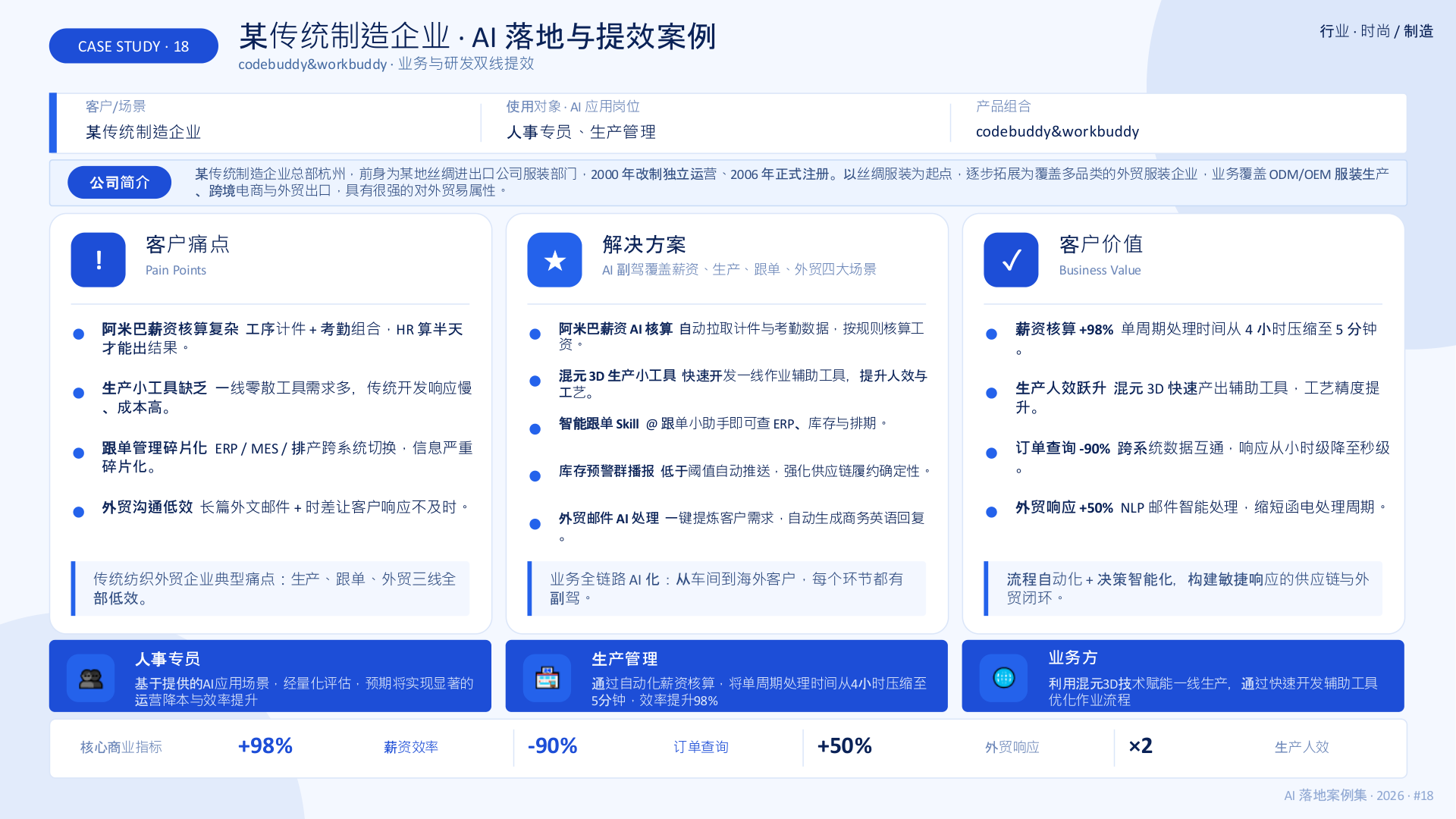
Traditional Manufacturer · End-to-End AI Enablement
Company-wide WorkBuddy deployment and scenario-based practical training improved efficiency across high-frequency business workflows.
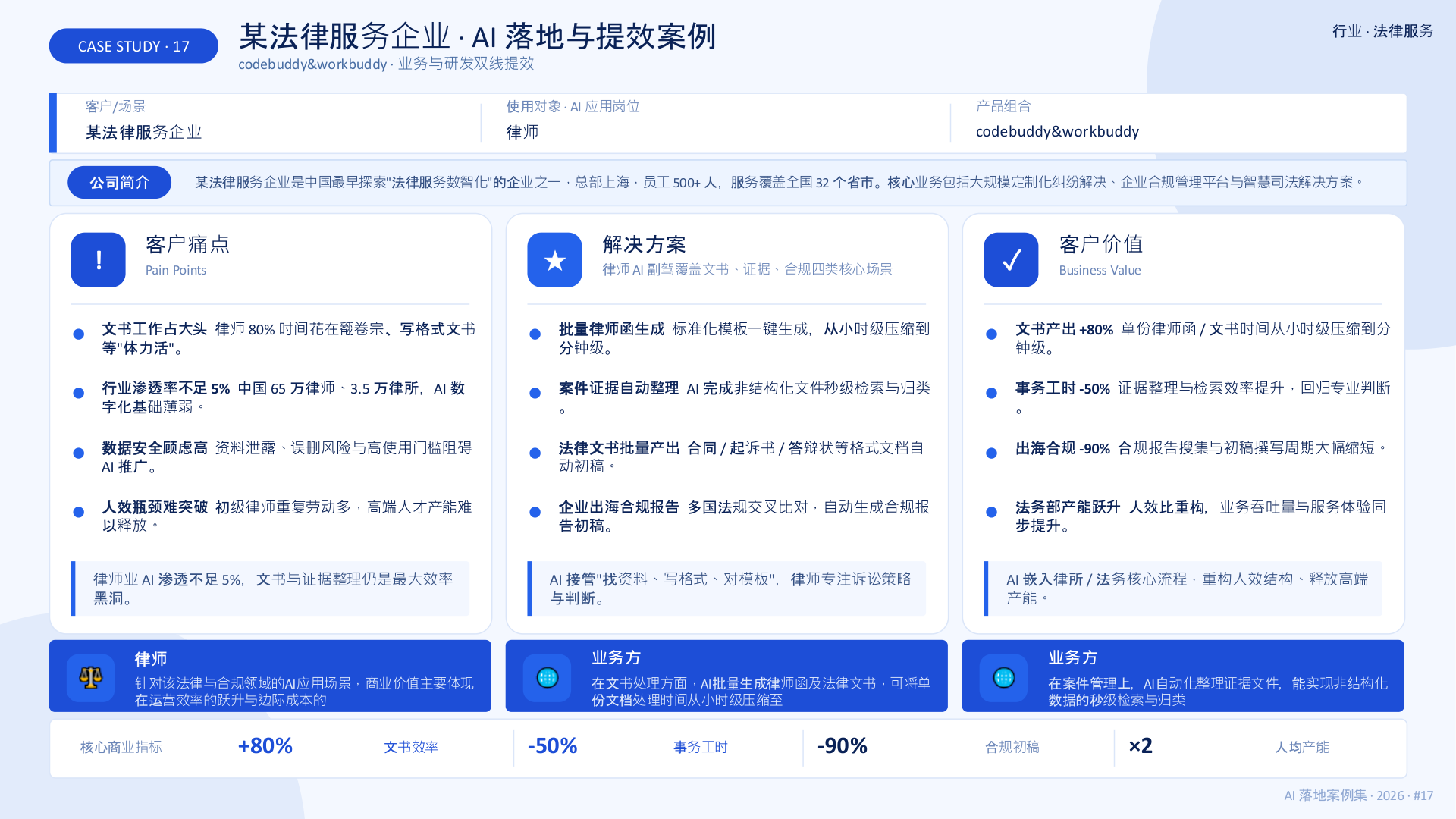
Legal Services Firm · Faster Document and Evidence Work
A law firm with more than 500 people introduced an AI copilot to accelerate batch document generation and evidence organization, doubling per-person capacity.
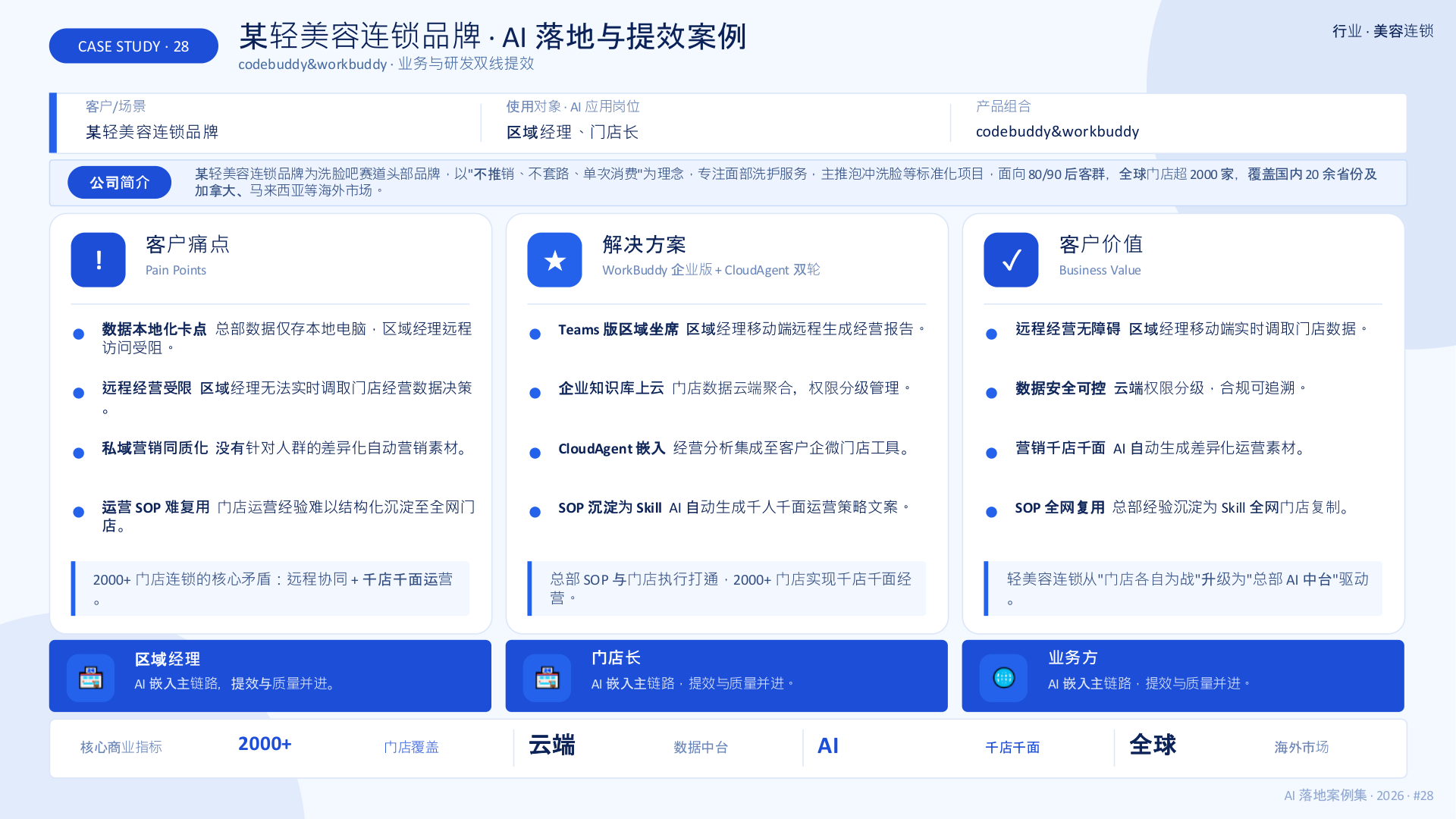
Light-Aesthetics Chain · Individualized Operations Across 2,000+ Stores
Head-office SOPs became reusable Skills for every store, regional managers gained real-time mobile operating reports, and AI automatically generated differentiated marketing materials.
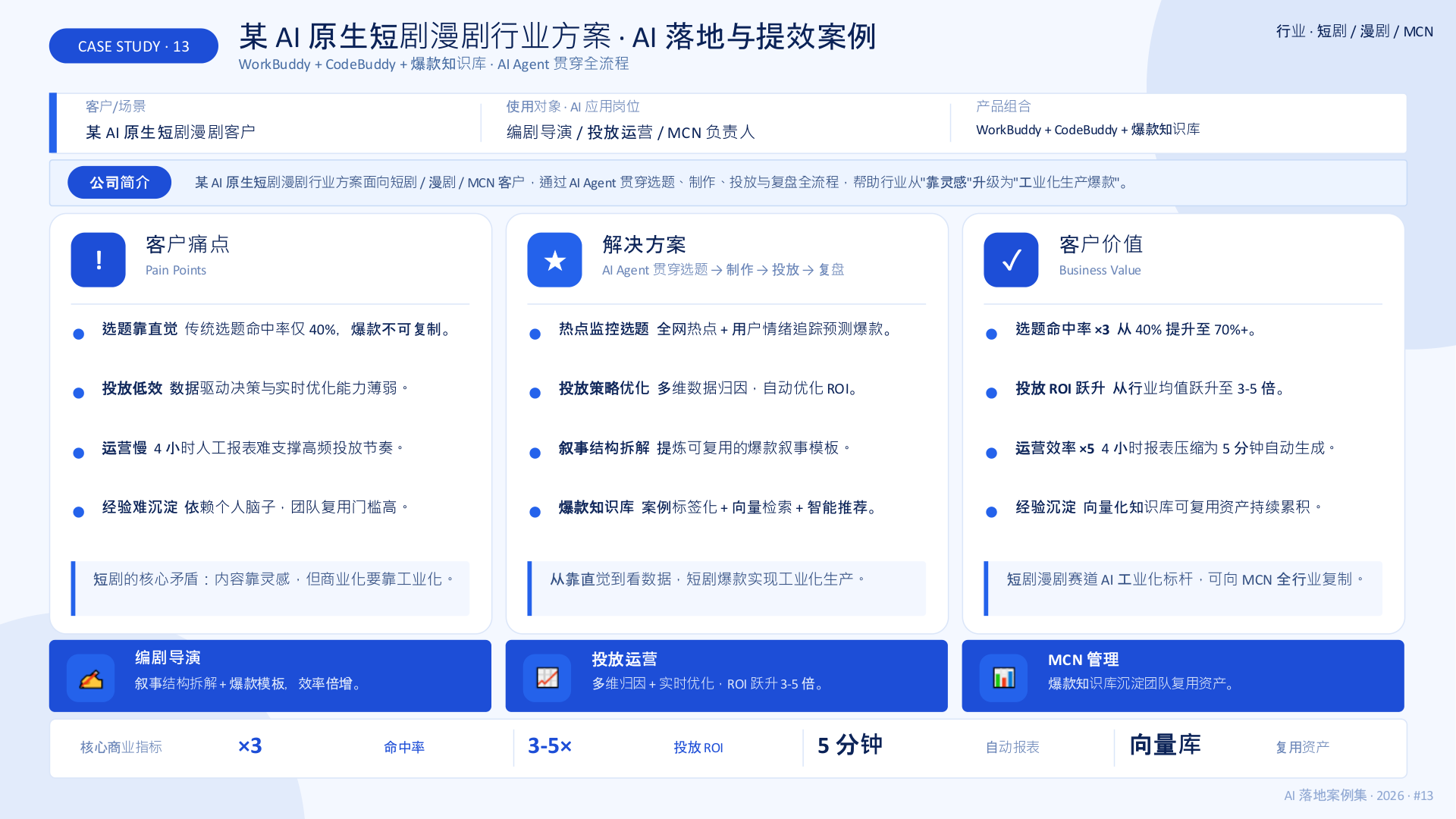
Short-Drama and Motion-Comic Client · Industrialized Hit Production
An AI Agent covered topic selection, production, media buying and review, lifting both hit-topic accuracy and advertising ROI.
Related articles
- What Is WorkBuddy? Its Positioning, Capabilities, and Boundaries Explained
- WorkBuddy vs WeCom, Feishu, and Coze: One Table to Clarify Which to Choose
- What WorkBuddy Can and Cannot Do: A Practical Boundary Checklist
- The First Step in Enterprise WorkBuddy Adoption: Start with One Use Case, Not Everyone
- How to Choose WorkBuddy Training: Four Criteria and a Sample Curriculum