AI Agents and Product Development
The hard part for a company is never buying a tool; it is getting a system to finish the work. We deliver that in two layers. The first is the AI agent, enabling AI to understand goals, plan autonomously and call tools to complete tasks. The second is product development, delivering the website, mini program or business platform that carries it. Only together do these layers produce an implementable result.
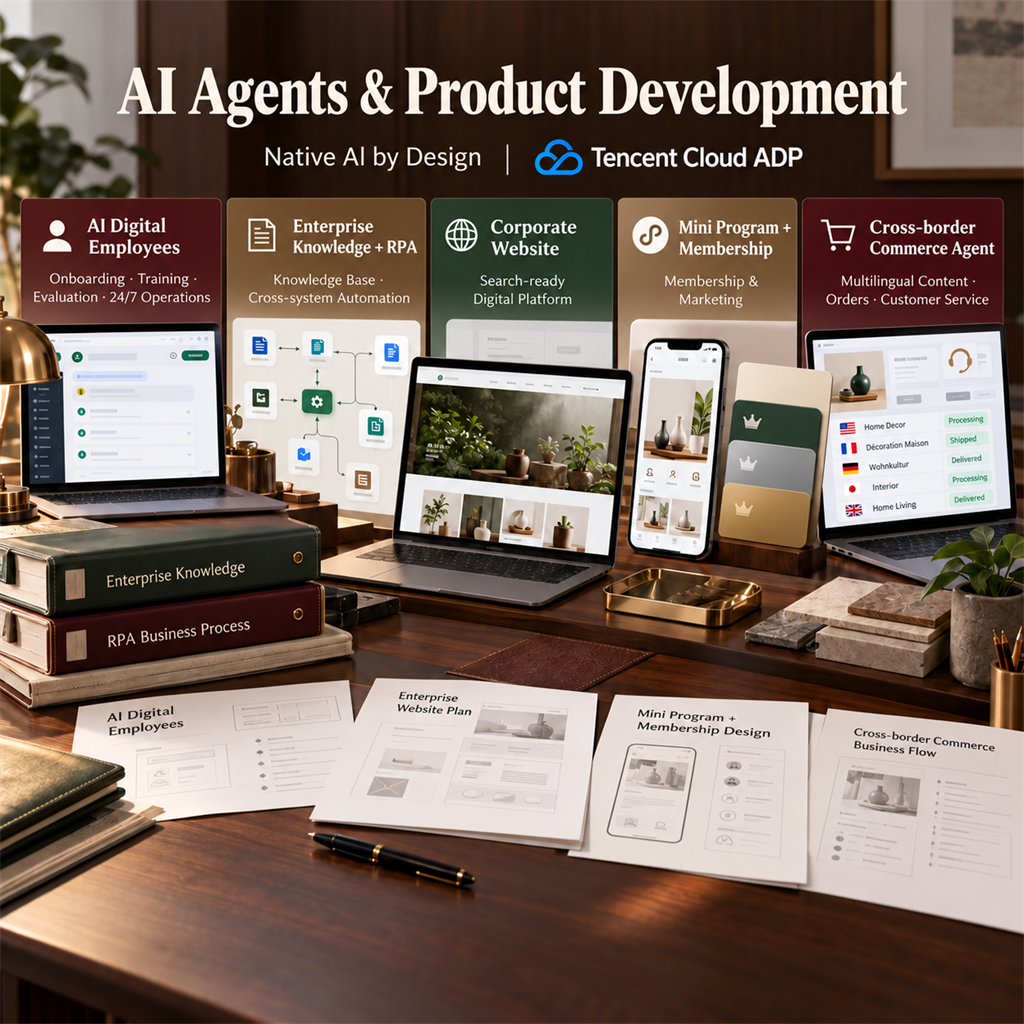
What Are AI Agents and Product Development?
An AI agent is an AI system that can understand a task goal, break it down and plan steps autonomously, call external tools and data, and adjust subsequent actions according to execution results. Its essential difference from traditional software is autonomy: traditional software follows a predefined process and stops at an undefined branch, while an agent chooses a path within granted permissions. Product development delivers production-ready digital products, including corporate websites, brand websites, membership and loyalty platforms, mini programs and lightweight business systems. They belong in one service line because each is a prerequisite for enterprise AI implementation: agents need systems to provide data and interfaces before they can act, and systems need built-in AI capabilities to avoid becoming frozen at launch. We deliver both layers, integrating agents as systems are delivered instead of building a traditional system first and retrofitting it later.
Why This Deserves Serious Attention
The term 'AI agent' is now used very broadly. Many companies buy a conversational knowledge base and believe they have completed an agent project. The test is simpler: can it complete a multi-step task without someone watching, and can it make the necessary judgements along the way?
We combine these two capabilities because we have seen too many projects succeed in the first half and stall in the second. The agent design is sound, but implementation reveals that business systems have no interfaces, information exists only in images or a client-rendered website cannot be read by crawlers. The redesign then costs far more than expected. When two vendors own the two halves, the handoff cost often exceeds the development itself.
5 Common Business Bottlenecks
Knowledge is scattered and hard to find
Policies, proposals and cases are distributed across personal computers, group chats, cloud drives and email. An employee may need to ask three people to find one document.
Repetitive work consumes the team
Repeated questions make up most enquiries, filling staff time with low-value answers while nights and holidays remain uncovered.
Existing software is not flexible enough
Purchased SaaS cannot match the company's business logic, custom development is expensive and slow, and each business change triggers another modification.
The website becomes useless after launch
It only displays information and generates no leads. Every content update requires an external vendor and costs hundreds or thousands of yuan.
An AI upgrade exposes a weak foundation
A planned AI support service or knowledge base reveals that all content is trapped in images and the system has no interfaces, making the upgrade extremely costly.
What We Deliver
Knowledge agents + enterprise knowledge bases
Consolidate scattered documents, policies, proposals and cases into a structured enterprise knowledge base, then use RAG (retrieval-augmented generation) so the agent answers from controlled sources and cites them, materially reducing hallucinations.
Task agents (digital workers)
Turn specific business workflows into agents that handle tickets, generate quotations, conduct follow-ups, convert meeting notes into actions and process files in batches. Multiple agents can collaborate in parallel and operate 7×24.
Cross-border business agents (cross-border ecommerce agents)
Agents for international business: batch production and localisation of multilingual content and assets, cross-border order and logistics-status handling, multilingual customer support, and collection and organisation of product-selection and competitor information, releasing cross-border teams from repetitive work.
Analytical agents
Connect business data sources so users can query data in natural language and generate summaries and operating reports automatically, turning weekly manual spreadsheet work into a question asked in one sentence.
Corporate websites and brand websites
Build to standards that search and AI engines can read: build-time static pre-rendering, complete structured data, semantic HTML, responsive design and performance optimisation, with a content admin that requires no development.
Mini programs and business platforms
Develop membership and loyalty systems, campaign platforms, supply-and-demand platforms, store mini programs and other business systems with administration and data analysis.
Business-system integration and embedded AI
Use APIs, the MCP protocol or data synchronisation to connect existing CRM, ERP, ticketing, WeCom and other systems, and embed AI support, knowledge retrieval and data Q&A when the system is delivered instead of building a traditional system and retrofitting it later.
Private deployment and security
Provide private deployment for data-sensitive scenarios, including permission systems, access auditing and data-boundary design so core information remains inside the required environment.
Evaluation and continuous iteration
Build an evaluation set before launch using real questions and correct answers, then track accuracy, refusal rate and adoption after launch. Provide staged content-update and optimisation recommendations to avoid a system that freezes at launch.
Deliverables
- Scenario design and feasibility-assessment report
- Enterprise knowledge base, including content consolidation and structuring plan
- Agent configuration, prompts and tool chain
- Website / mini program / business-system delivery
- Business-system integration plan and interface inventory
- Content administration + operations manual + outcome-tracking dashboard
Implementation Process
- 01
Scenario assessment
Inventory candidate scenarios, rank them by frequency × time consumed × tolerance for error, and select the 1 to 2 most valuable for the first phase. Assess how easily existing systems can connect and whether they need to be redesigned at the same time.
- 02
Knowledge and data preparation
Collect and clean knowledge sources and map data interfaces. This workload is usually seriously underestimated, but it determines both the agent's performance ceiling and the amount of system development required.
- 03
Development and configuration
Run two tracks in parallel: configure the agent's role, capability boundaries, tool chain and retrieval strategy; design and develop the website or business system and embed AI capabilities directly.
- 04
Evaluation and launch
Use a real question set for pre-launch evaluation, focusing on accuracy, refusal rate and error types. Complete cross-device compatibility and performance checks on the system, then launch to a small group once standards are met.
- 05
Iterative operation
Collect failure cases from real use, continue expanding knowledge and tuning the system, and provide phased recommendations for feature expansion and content improvement.
Who It Fits
Good fit
- Organisations with large volumes of repeated enquiries or transaction work that consume staff time in low-value responses
- Companies with substantial but scattered knowledge assets such as documents, policies and cases, creating high retrieval costs
- Companies whose existing software cannot fit their business logic but that do not need an entirely new system
- Companies with an outdated display-only website or a need to unify membership and store data, and that want AI built in this time
Not recommended
- Organisations expecting an agent to replace professional judgement completely; human review must remain in scenarios involving legal liability, medical diagnosis or financial decisions
- Organisations with no knowledge assets that also will not organise any; a knowledge base is the agent's fuel, and without fuel there is no outcome
- Organisations needing only a general chat tool or a template website; an off-the-shelf product is more economical for the former, and we do not provide low-spec template delivery for the latter
Approach Comparison
| Path | Principle | Advantage | Limitation |
|---|---|---|---|
| Direct answer from a general model | Relies on knowledge retained during model training | No material preparation and ready to use | Can invent specialist information, cannot guarantee accuracy and cannot provide sources |
| RAG retrieval-augmented generation | Retrieves relevant enterprise knowledge first and answers from the retrieved material | Controllable, traceable and updatable answers with materially fewer hallucinations | Requires investment in knowledge collection and cleaning; knowledge quality sets the performance ceiling |
| Fine-tuning | Continues training the model on enterprise data | Can learn an answer style and specific forms of expression | Expensive and slow to update, making it unsuitable when knowledge changes frequently |
Three technical paths for enterprise knowledge Q&A
Frequently Asked Questions
What is the difference between an AI agent and an enterprise knowledge base?
A knowledge base is the material; an agent is the employee that knows how to use it. A knowledge base centralises and retrieves information. An agent adds the ability to understand goals, break down steps, call tools and complete tasks. In practice, the knowledge base is normally built first and the agent is constructed on top of it. The knowledge base is the agent's fuel.
What is RAG, and why should an enterprise knowledge base use it?
RAG, or retrieval-augmented generation, works as follows: when a user asks a question, the system first retrieves the most relevant passages from the enterprise knowledge base, then gives those passages to the large language model and requires it to answer from them. This makes answers controllable, traceable through sources and updateable as knowledge changes, while materially reducing fabricated answers. Compared with fine-tuning, RAG is better suited to frequently changing knowledge.
How should an AI agent platform be selected?
Evaluate four questions before comparing feature lists: can your data leave its environment, which determines public-cloud versus private deployment; must the agent operate local files and a desktop; how can it connect to existing systems, considering APIs and connector ecosystems; and who will maintain it, which determines no-code versus orchestratable platforms. Major platforms have different strengths: Tencent WorkBuddy in local operation and Tencent ecosystem integration, ByteDance Coze in multi-agent orchestration, Feishu in table and IM integration, and DingTalk Wukong in native DingTalk capabilities. The best platform is the one that matches your constraints.
What problems can a cross-border ecommerce agent solve?
It reduces costs in three main areas: batch production and localisation of multilingual content drafts, releasing content capacity from human bottlenecks; automated multilingual customer support and cross-border order-status handling, shortening response times and covering time-zone differences; and automated collection and organisation of market and competitor information to support product selection and pricing. Its role is to improve human efficiency across the chain, not replace human creativity and judgement.
Will an agent fabricate answers, and how can that be controlled?
The risk exists but can be reduced materially. There are four control layers: use RAG so answers rely on controlled sources instead of model memory; require sources so people can verify the answer; define capability boundaries so the agent refuses when the knowledge base has no answer; and maintain an evaluation set of real questions to test accuracy and refusal rate continually. Human review is mandatory for legal liability, medical and financial-decision scenarios.
How much does an AI agent cost, and how long does it take?
The range is wide and depends on scenario complexity, knowledge-organisation work and systems integration. A knowledge agent focused on one scenario, such as internal policy Q&A, can usually launch in 2 to 4 weeks. A task agent involving several systems and workflow execution is normally phased, with a first phase of 4 to 8 weeks. Pricing follows a scenario assessment. We do not offer one standard price for every agent, because that usually means knowledge-preparation costs were omitted or will be added later.
How is your website and systems development different from an ordinary website company?
There are three material differences. First, we build for readability by search and AI engines from the start, using build-time static pre-rendering, structured data and semantic HTML, instead of adding SEO afterwards. Second, the content admin requires no development, so you can update content without paying a developer each time. Third, because we implement enterprise AI, we can embed AI support and knowledge retrieval during delivery and avoid the cost of a second redesign.
Can you improve my existing system instead of rebuilding it?
That depends on the technical foundation. If only the visuals are dated and the structure is sound, improvement is practical. If pages depend on client-side JavaScript rendering, structured data is absent, content cannot be updated through the admin or no usable interfaces exist, improvement may cost almost as much as rebuilding while preserving architectural constraints. We first conduct a technical assessment and compare the costs and benefits of improvement and rebuilding for you to decide.
Can an agent be deployed privately?
Yes. For scenarios involving client information, financial data or core business logic, we recommend private deployment with a permission system, access auditing and data-boundary design. The detailed plan must be confirmed with your IT or security lead, including compute resources, model selection and allocation of operations responsibilities.
First decide which scenario is worth turning into an agent
Tell us the one repetitive business problem you most want to solve. We will assess for free whether an agent is suitable, which implementation path to use and what must change in the existing system.
Related Cases
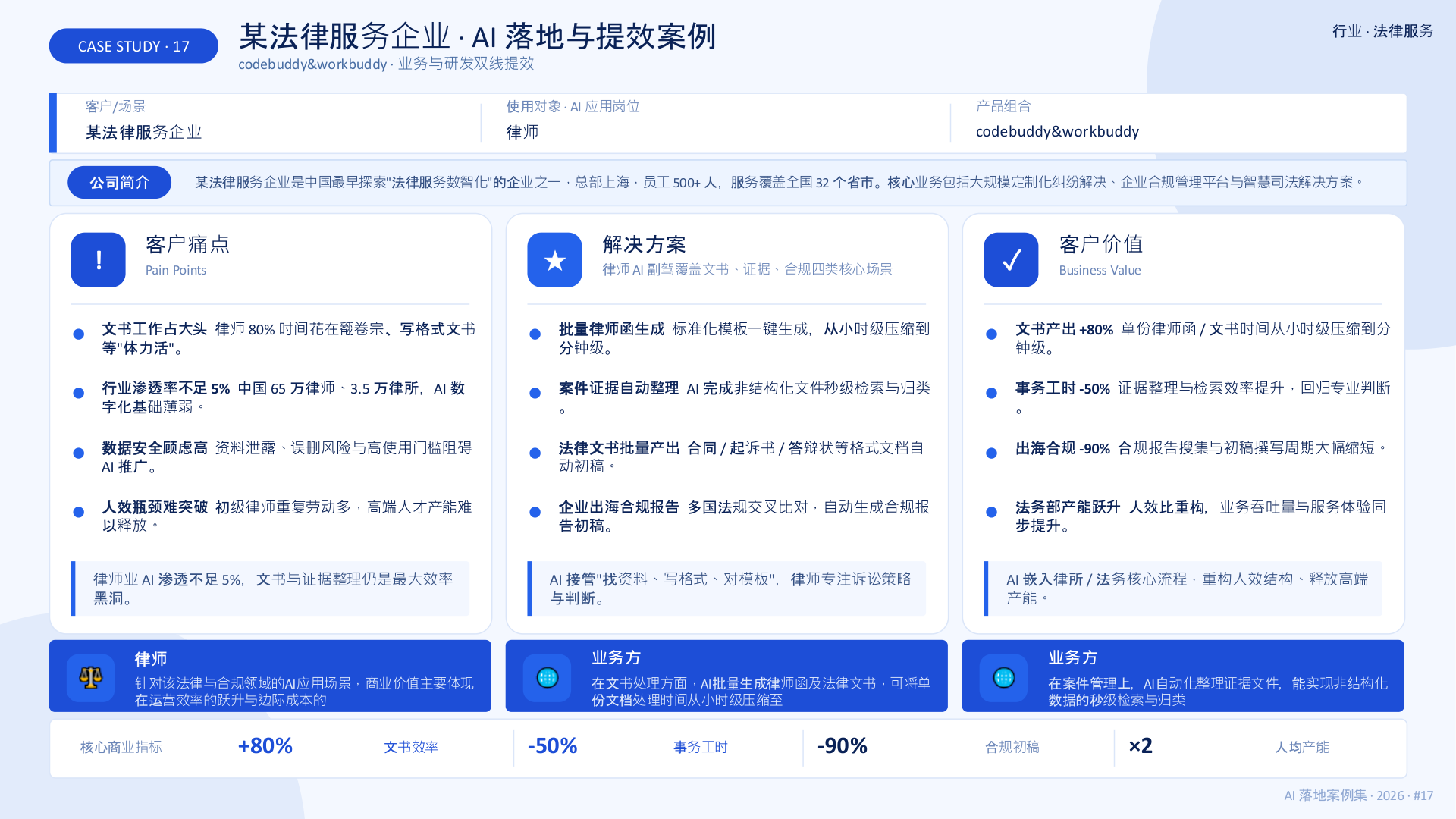
Legal Services Firm · Faster Document and Evidence Work
A law firm with more than 500 people introduced an AI copilot to accelerate batch document generation and evidence organization, doubling per-person capacity.
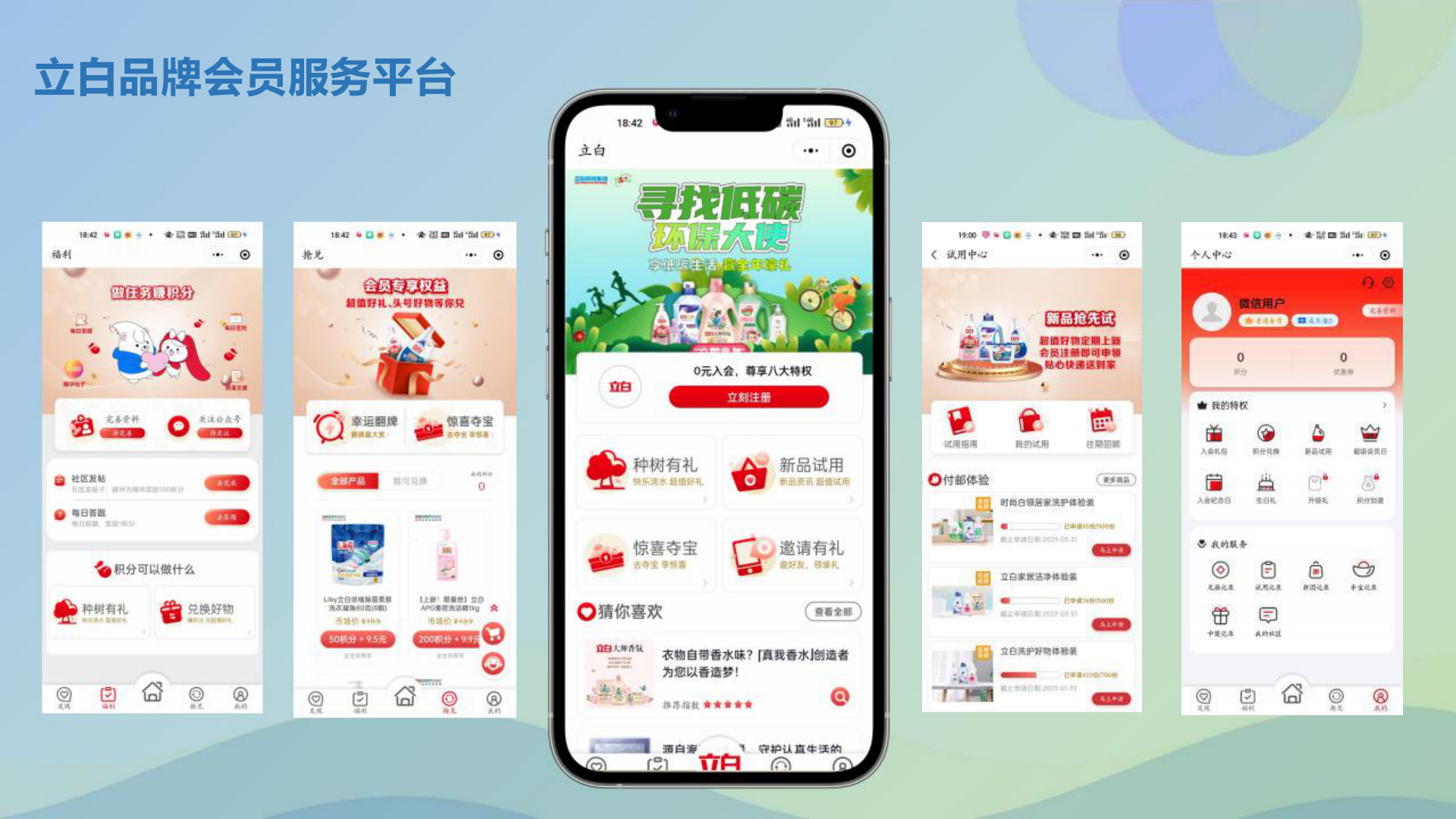
Liby Brand Membership Service Platform
A brand membership service platform for Liby, a leading household-care brand, supported member operations and marketing campaigns.
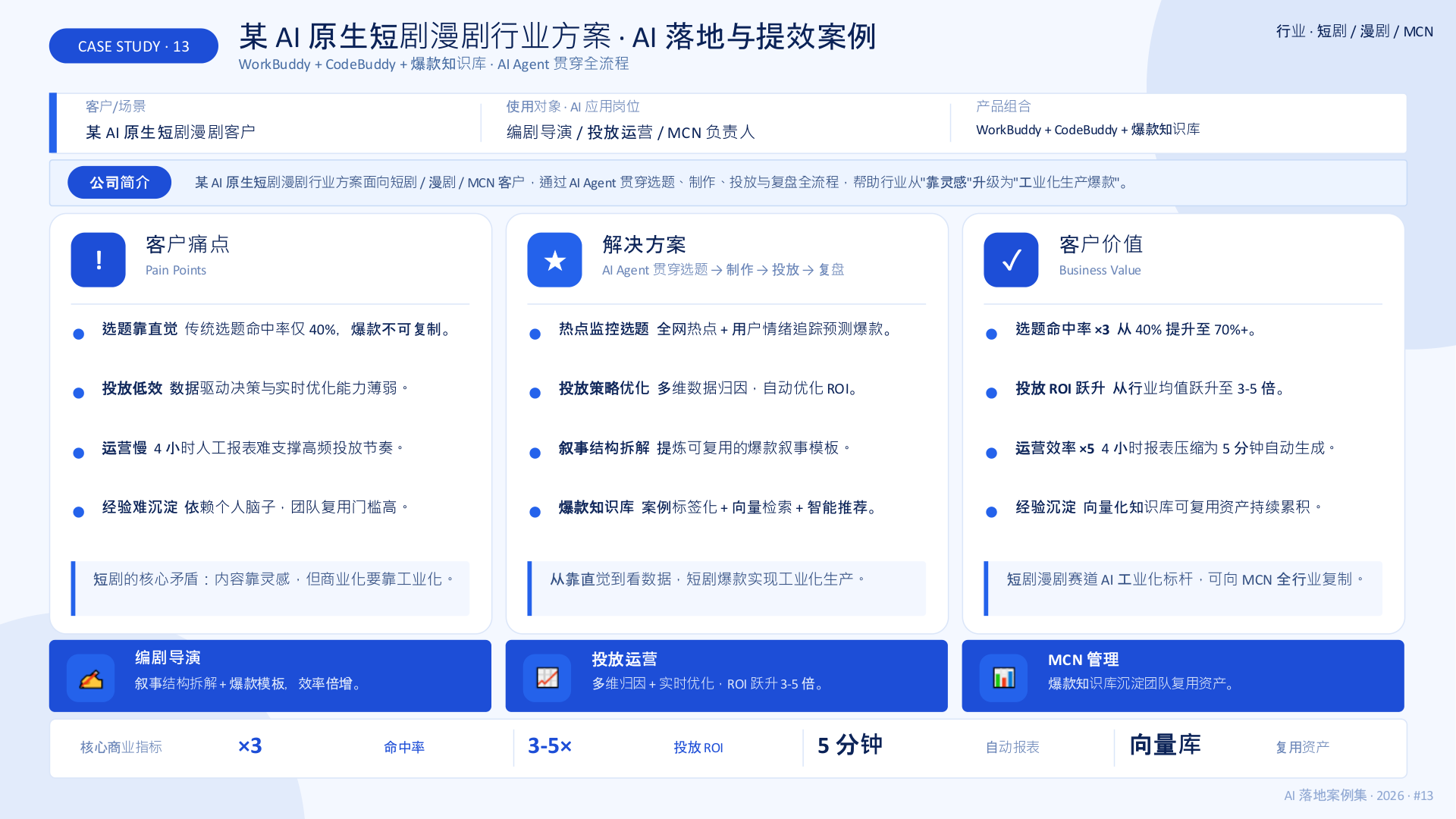
Short-Drama and Motion-Comic Client · Industrialized Hit Production
An AI Agent covered topic selection, production, media buying and review, lifting both hit-topic accuracy and advertising ROI.
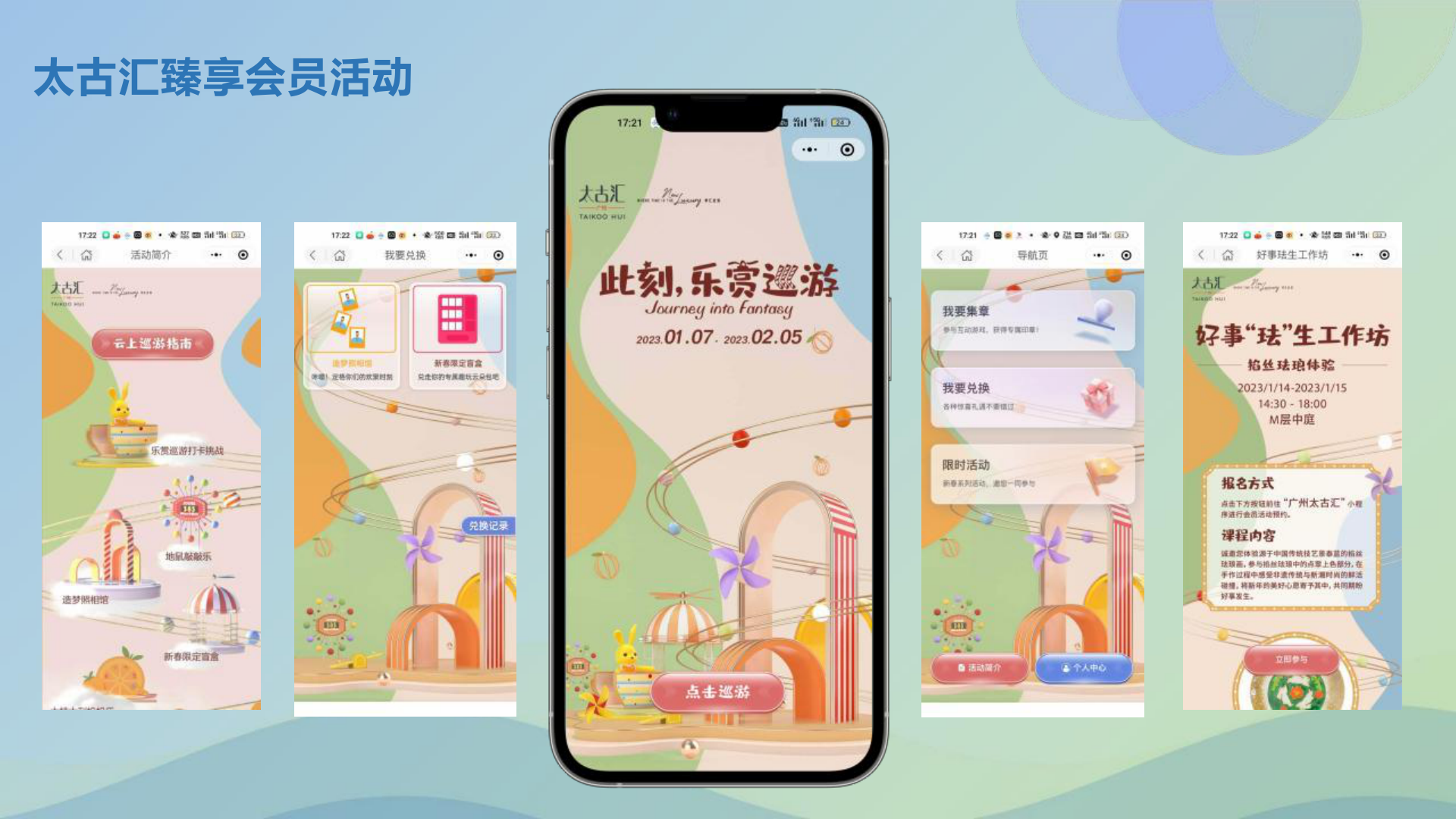
Taikoo Hui Premium Member Event Platform
A premium member event platform for the high-end Taikoo Hui shopping complex supported member benefits and event operations.