GongBan AI Team | Shenzhen | About an 8-minute read
For manufacturers, the most valuable first AI move is not choosing a large model — it is the concrete tasks that drain manpower every day: payroll calculations, cross-system order lookups, foreign-trade email. GongBan AI has organized the scenarios we have delivered for trading and manufacturing companies, along with the screening method and rollout path, into this checklist you can run against your own shop floor and office, item by item.
A 2025 report by the MIT NANDA project found that about 95% of enterprise generative AI pilots produced no measurable P&L impact — the problem is usually not the model but the wrong entry scenario. Manufacturing bosses' time is expensive, so this article covers just three things: which scenarios deserve to go first, how to screen them, and how to roll them out.
First, What a Real Result Looks Like
The conclusion up front: with the same people and the same tool, picking the right scenario makes the efficiency gain fully calculable.
A traditional foreign-trade manufacturer with a weak digital foundation handled payroll, cross-system order queries, and trade communication entirely by hand. GongBan AI's approach was a company-wide WorkBuddy deployment with scenario-based hands-on training around three high-frequency tasks. The delivered results:
| Scenario | Before | After | Change |
|---|---|---|---|
| Profit-center payroll calculation | 4 hours | 5 minutes | 98% faster |
| Cross-system order lookup | Hours | Seconds | 90% less time |
| Trade email response | Handled manually, one by one | Templates + assisted drafting | 50% faster response |
(These figures correspond to that project and its disclosed basis only; they are not a promise of results for other projects.)
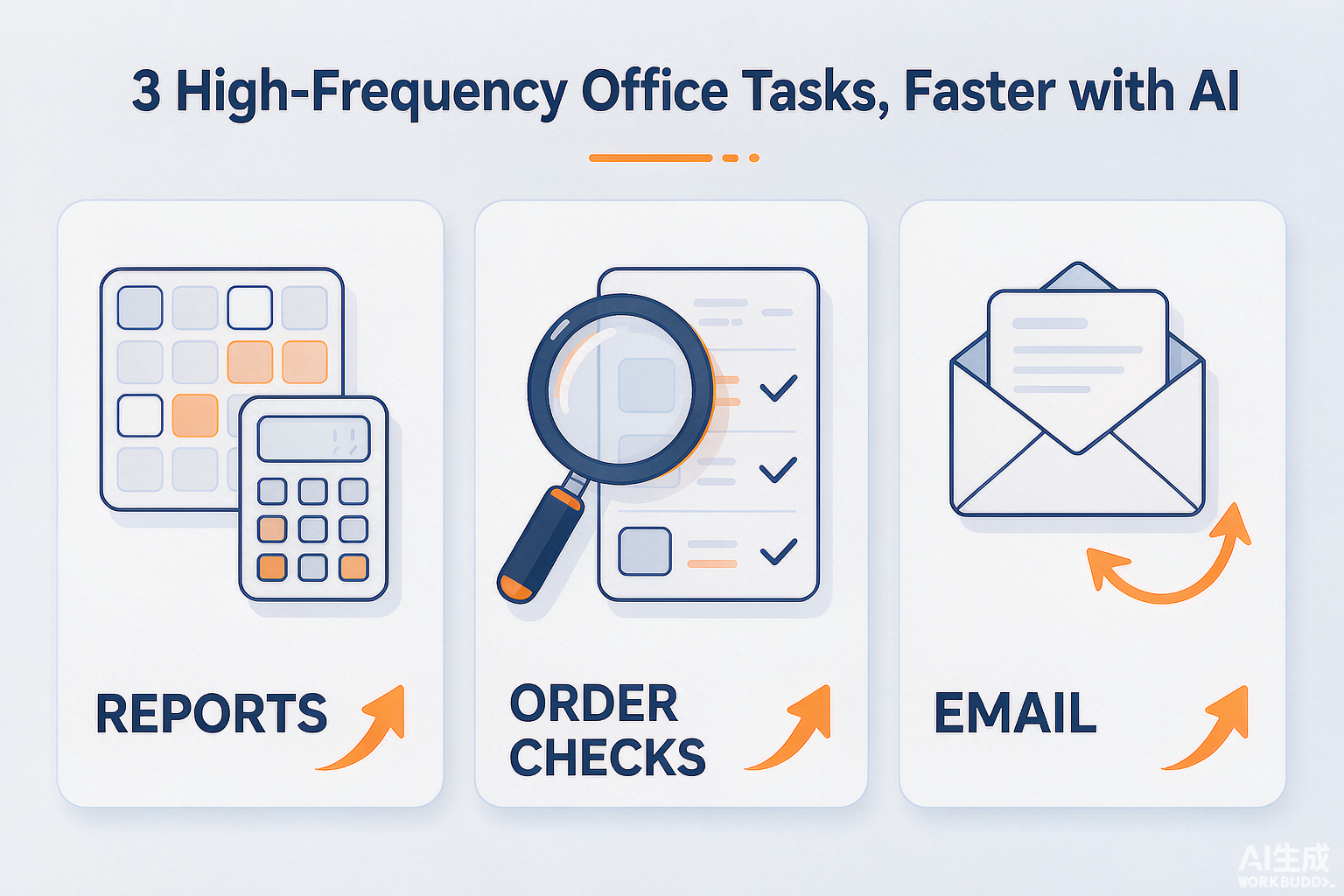
What deserves attention is not the three numbers but what the three scenarios share: none is glamorous, and all of them happen every single day.
The Checklist: 8 AI Scenarios for Manufacturers
Each scenario below follows the pattern "what / who / how / watch out." The first two carry real data from the project above; the rest are common scenarios we have not replaced end to end — copy the format directly.
1. Profit-center and payroll calculation reports. What: consolidating output, hours, and unit prices from multiple spreadsheets into a calculation sheet by fixed rules. Who: factories with many workshops and fixed accounting cycles. How: write the calculation rules as steps for the AI to execute; people only review anomalies. Watch out: the rules must be documented first — skip scenarios where the rules themselves are vague.
2. Cross-system order lookup and consolidation. What: salespeople must log into ERP, warehouse systems, and logistics sheets to check one order status. Who: factories running multiple systems without integrated APIs. How: the AI reads exported data from each system under authorization and unifies them into one query entry. Watch out: this involves system permissions — agree on data boundaries with IT and management first.
3. Trade email follow-up and quote drafts. What: inquiry triage, follow-up email generation, first-draft quotations. Who: teams where each trade salesperson handles dozens of emails a day. How: templates + assisted drafting — the AI drafts, the salesperson edits and sends. Watch out: prices and terms must be signed off by a human; the AI only drafts.
4. Production and inspection daily reports. What: consolidating each crew's written reports and photos into one operations daily. Who: factories with many crews and inconsistent report formats. How: fix a daily-report template; the AI consolidates on schedule and flags anomalies. Watch out: unify report formats first — do not automate chaos.
5. Contract and purchase-order clause comparison. What: clause-by-clause comparison of new contracts against templates, with differences flagged. Who: factories with frequent procurement and thin legal support. How: the AI outputs a difference list; legal or the owner reviews. Watch out: conclusions must be signed off by a human; the AI only compares.
6. Meeting minutes and structured task lists. What: turning production-coordination meeting recordings into minutes with action items and owners. Who: factories with many cross-department coordination meetings. How: authorize the recordings; the AI drafts the minutes. Watch out: recordings are involved — inform participants in advance.
7. Quality-inspection and after-sales record archiving and search. What: digitizing paper or scattered QC and complaint records into a searchable knowledge base. Who: export-oriented factories under heavy quality-traceability pressure. How: structure and archive first, then connect AI Q&A. Watch out: this is slow work — do not expect results in a month.
8. Inquiry classification and first response. What: automatic inquiry triage (real inquiry / price shopping / spam) and first-reply drafts. Who: teams with high inquiry volume and slow sales follow-up. How: AI classifies and tags + drafts; sales confirms and sends. Watch out: review the classification rules monthly.
How to Decide Which Scenario Goes First: the Six-Criteria Score
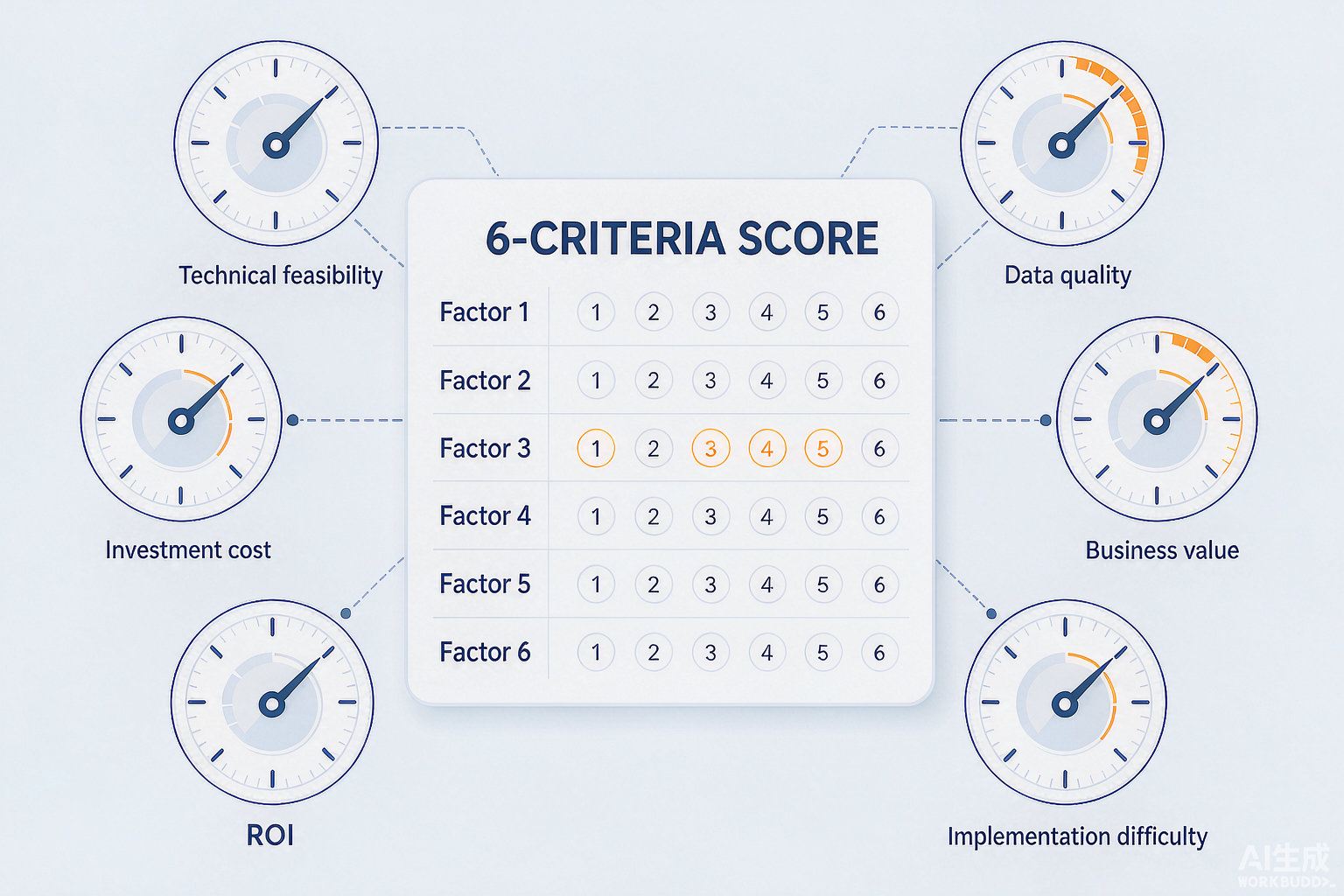
The one-sentence answer: do first the scenario that scores on all six — done daily, time-consuming, clear rules, data at hand, errors recoverable, an owner accountable.
Internally we score six criteria, 1–5 points each; scenarios below 20 points total get deferred:
| Criterion | Question | High-Score Signature |
|---|---|---|
| Frequency | How often is this done? | Daily or weekly |
| Time cost | How long does one run take? | Over 30 minutes each time |
| Rule clarity | Can "done" be defined in writing? | Clear acceptance criteria exist |
| Data availability | Where is the required material? | Already digitized and accessible |
| Error tolerance | How costly is a mistake? | Human review can catch errors |
| Owner | Who answers for the result? | A clear business owner exists |
Take this sheet and score the three to five most annoying tasks on your shop floor and in your office — the answer usually surfaces on its own.
The Four-Step Rollout: From Chosen Scenario to Real Results
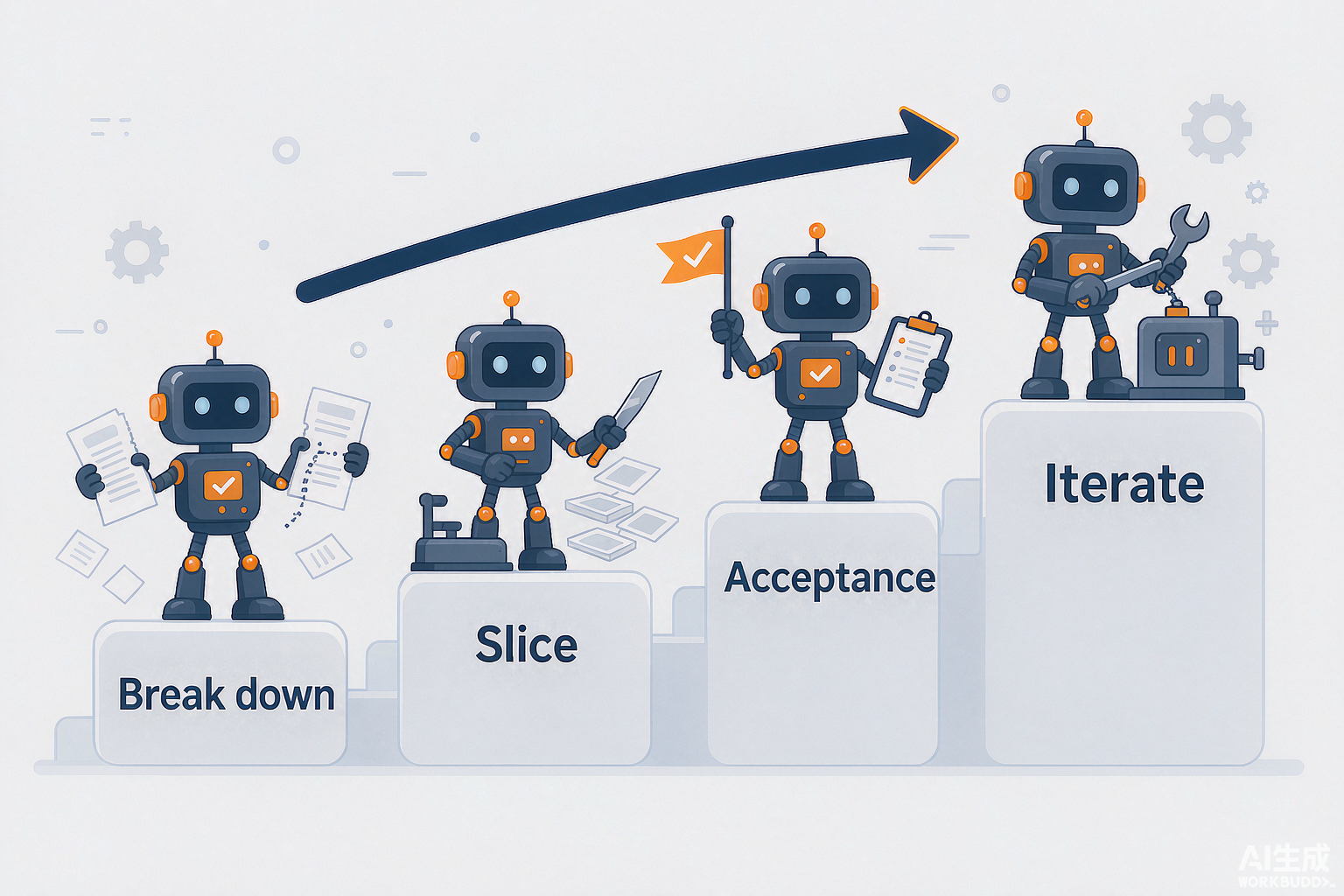
The one-sentence answer: break down the process, slice it, set acceptance, run two weeks, then adjust.
- Break down the process: write the task end to end as steps, marking each step's inputs, outputs, and decision rules. Many factories discover at this very step that the process was never clearly articulated even internally.
- Slice it: divide into "what AI can do" and "what humans must do." The principle: let AI handle repetition, retrieval, generation, and comparison; let people handle judgment and sign-off.
- Set acceptance: agree on metrics before launch — time cost, output volume, error rate. A transformation without metrics always ends as "it feels faster."
- Run two weeks, then adjust: surprises are guaranteed in the first two weeks. Leave an adjustment window; do not announce on launch day.
When Not to Start, and How Long It Takes
First, what not to do: scenarios requiring professional judgment and accountability (quality-incident liability, safety decisions) should not have AI in the lead; legacy systems without APIs will not be connected by AI with one click — evaluate connector options first; processes whose rules are still changing (new-line trial production) should wait.
On timelines: from our own delivery experience, single-point scenarios show quantifiable change in 2–4 weeks; cross-department process transformation usually takes 2–3 months. If no metric has moved after six months, the scenario was almost certainly wrong — cutting losses promptly beats pushing harder.
AI adoption in manufacturing is like re-tooling a workshop with new jigs — the jig itself produces no parts, but it determines how fast and how consistently every worker can work. Pick the wrong jig and the best machine tool is wasted.
The right order for AI in manufacturing: find the concrete problem that drains manpower every day, then talk tools, training, and company-wide rollout. To find out which scenario your factory should start with, book a free enterprise AI diagnosis from GongBan AI.
Further Reading
- The First WorkBuddy Enterprise Step: A Four-Step Method for One Scenario
- The First Step in Enterprise AI: Choosing the Right Use Case
- A Traditional Manufacturer: Full-Chain AI Transformation (Case Study)
References
- MIT NANDA, The GenAI Divide: State of AI in Business 2025, as reported by Fortune, 2025-08-18, https://fortune.com/2025/08/18/mit-report-95-percent-generative-ai-pilots-at-companies-failing-cfo/
- GongBan AI case study: a traditional manufacturer — full-chain AI transformation, https://www.gongbanai.com/en/case/mfg.html (data represents that project only)