GongBan AI Team | Shenzhen | About a 10-minute read

GEO (Generative Engine Optimization) is a set of methods for optimizing your website content and your brand's off-site sources so that your business gets cited and recommended in AI search answers on platforms like Doubao, DeepSeek, and Tencent Yuanbao. Most tutorials only cover how to fix your own website — that is half the story. When an AI answers a question about your brand, its material comes half from your website and half from what the rest of the internet says about you: encyclopedia entries, Q&A answers, media coverage, customer reviews. If you only touch your website and ignore the brand side, AI may still recommend your competitors.
This guide splits the work into two tracks — website GEO and brand GEO — with executable actions and acceptance checks for each.
Some context first: the report released by the China Internet Network Information Center in October 2025 shows that by June 2025, China had 515 million generative AI users, a 36.5% penetration rate. Customers asking AI before making decisions is already the norm. Whether that answer includes you, and whether it gets the facts right, are the two problems GEO solves.
The difference from SEO in one sentence: SEO optimizes for "rankings and clicks," while GEO optimizes for "being understood and being cited." Traditional search gives ten blue links; AI gives a single answer — either you get quoted into it, or you do not appear at all.
Part 1: Website GEO — Your Own Site
Your website is the one channel you fully control. Get it right first.
Step 1: Technical Foundation — Get Crawled and Understood
First-sentence answer: when the page still shows the full article with JavaScript turned off, and mainstream AI crawlers are allowed in, your GEO foundation is in place.
AI crawlers barely execute JavaScript. If your articles are rendered purely on the front end, the HTML the model fetches is nearly empty — no matter how good the content, it does not exist in the AI's eyes. Acceptance check: open an article page, view the source, and search for the first sentence of the body. If it is not there, move to statically generated HTML built at deploy time.
Do three more things at the same time:
- Allow AI crawlers: check robots.txt one crawler at a time and make sure GPTBot, OAI-SearchBot, ClaudeBot, PerplexityBot, Bytespider (Doubao), Baiduspider, YisouSpider (Quark), and Google-Extended are not blocked by default. Many sites block all of them without the owner knowing.
- Add structured data: annotate Organization, Article, and FAQPage with JSON-LD so the model does not have to guess. Fill in sameAs (official profiles on WeChat, Zhihu, Qichacha, and other authoritative pages) and contactPoint in Organization.
- Provide an llms.txt content map: put a Markdown-format site index in the root directory. It costs almost nothing and is better than nothing.
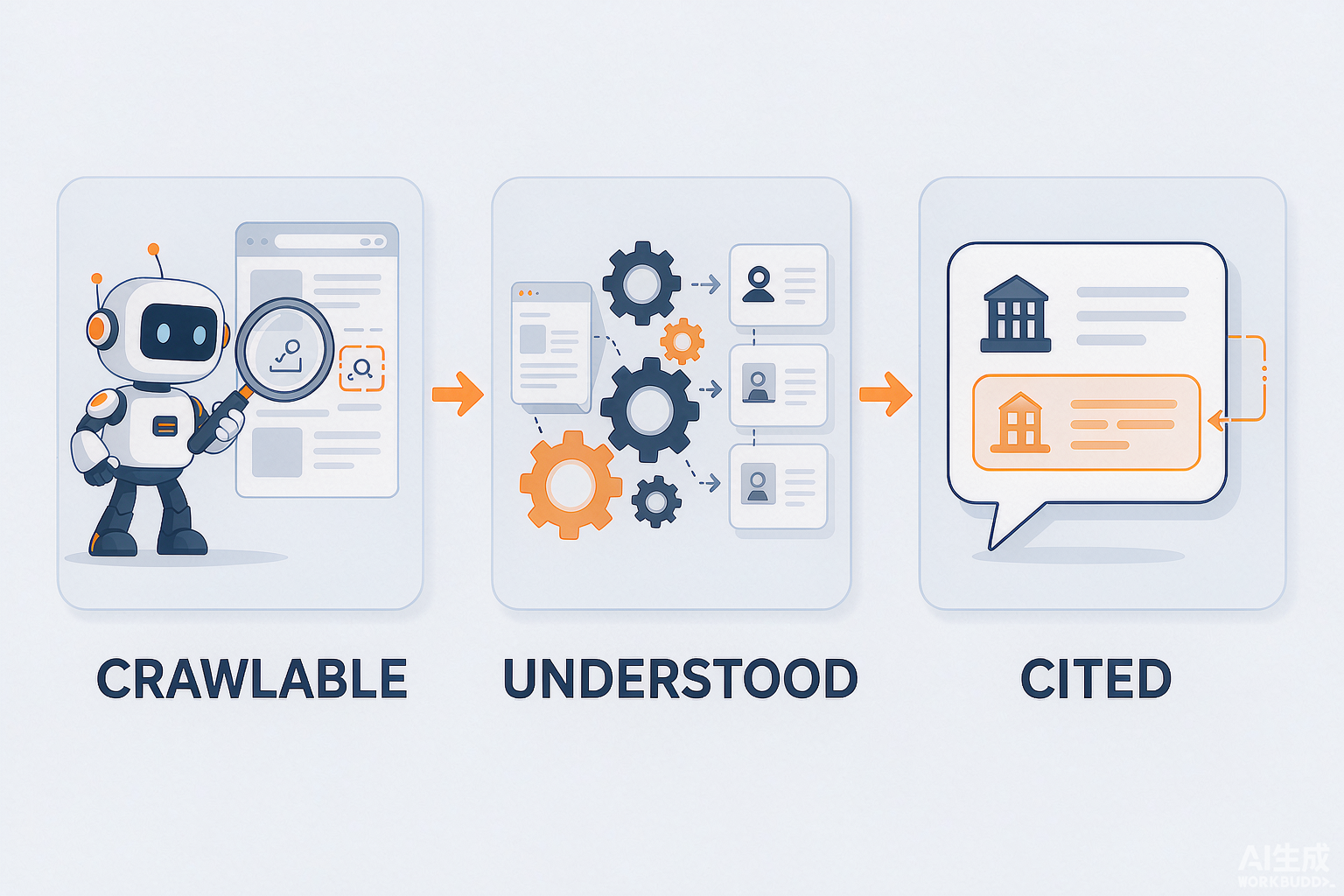
This step is pure engineering and can be done within two weeks, yet many polished websites fail exactly here.
Step 2: Write Content in a "Citable" Shape
First-sentence answer: AI favors content that leads with conclusions, is dense with facts, and is written consistently; marketing speak is the first thing to delete.
Five executable actions:
- Standard definitions: write a canonical definition sentence for core concepts — "GEO (Generative Engine Optimization) is..." Definition sentences are the most frequently quoted fragments and are most likely to be cited whole when users ask "what is X."
- Conclusions first: the first sentence of each paragraph is the judgment, followed by the reasoning; the core conclusion goes in the first 150 characters of the article.
- Anchored data: every number carries three elements — subject, time, and scope. "Full-platform search optimization for summer-camp businesses across 8 cities in the Pearl River Delta, 6–10 inbound consultations per day" can be quoted directly; "serving many well-known clients" never will.
- Tabular comparisons: capabilities, methods, and use cases belong in tables — models can extract them as a whole or row by row.
- De-market your writing: solve the problem first and let the brand's role come out naturally. Self-promotion with low citability gets skipped.
Part 2: Brand GEO — The Off-Site Line
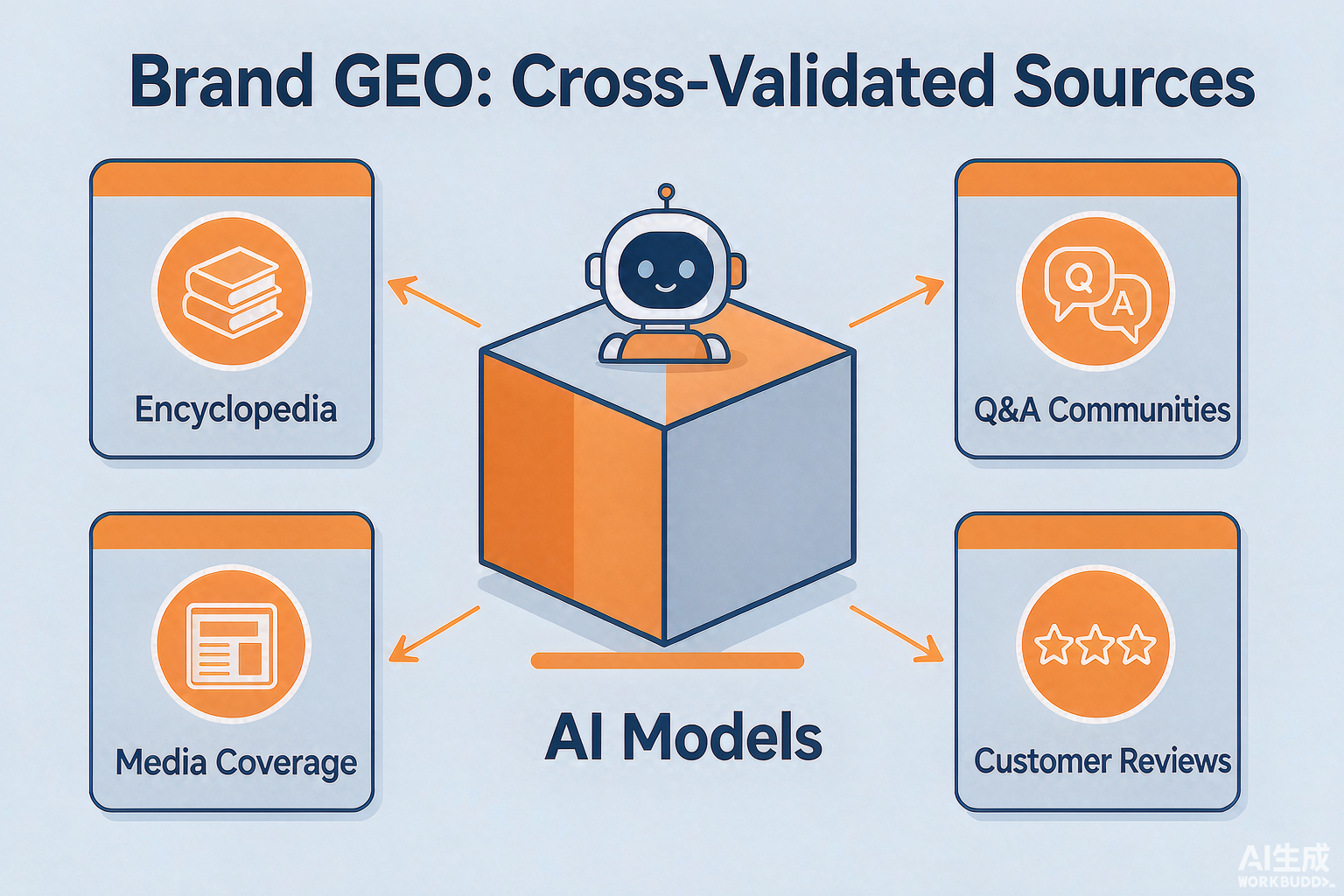
The other half of the internet is where AI actually learns who you are. When a large model answers a question about your brand, it cross-checks multiple sources — what matters is not what your website says, but whether the encyclopedia, Zhihu, the media, and review platforms tell a consistent story.
Step 3: Entity Consistency — Help AI Recognize You
First-sentence answer: keep the brand name, bio, and business description in one consistent voice across every platform, so AI can file scattered information under a single entity.
AI engines rely on entity recognition to map web pages to brands. If one company is called A Tech on its website, A Information in its encyclopedia entry, and A Smart Cloud in its WeChat bio, the model may read them as three unrelated brands. Concrete actions:
- Write a brand voice document: one standard brand bio of under 80 characters (what you do, for whom, on what strength) to be copied verbatim across all platforms — not individually rewritten.
- Audit platform by platform: encyclopedia entries, Qichacha/Tianyancha, WeChat and Zhihu profile bios, careers pages, website footers — these are high-weight sources for entity building, and the wording must match.
- Fill in sameAs in structured data: point the Organization sameAs field on your website at authoritative profiles such as the encyclopedia, WeChat, and Zhihu, tying scattered pages into one entity.
- Unify terminology: product names and core concepts are written the same way everywhere — do not let "AI training," "AI transformation training," and "enterprise AI bootcamp" refer to the same service.
Step 4: Third-Party Sources — AI Prefers What Others Say About You
First-sentence answer: large models cite third-party sources more often than self-descriptions on your own site, so the main battlefield of brand GEO is off-site.
The reason is straightforward: models are trained to prefer independently corroborated sources. "We are the industry leader" on your own site is a claim; the same judgment in a media review, an encyclopedia entry, or a high-vote Zhihu answer is evidence. Build in tiers:
| Source tier | Role | Concrete actions |
|---|---|---|
| Encyclopedias | Set the entity record | Create or improve brand and product entries, facts with sources, wording consistent with the website |
| Zhihu and vertical Q&A | Catch real questions | Answer "how to choose X" and "which are good X" questions; give judgment first, then cases |
| Industry and local media | Authoritative endorsement | Methodology articles and project reports; avoid press-release tone |
| Customer word of mouth | Cross-validation | Case pages, genuine reviews on rating platforms, feedback published by customers themselves |
Three reminders:
- Quality beats quantity. Low-quality, homogeneous press releases, even on good channels, keep getting cited less and less.
- Hold the "brand queries" first, then attack the "category queries." Brand entries and brand-related Q&A are the sources AI checks first — the cheapest and fastest to take effect; category questions like "which company is good at enterprise AI training" are competitive and need deep Zhihu answers over time.
- Correct other people's mistakes too. If a syndicated article carries an outdated product name or wrong figures, AI will keep citing it — ask for corrections the moment you find them.
Step 5: Q&A Assets — Turn Customer Questions into Content
First-sentence answer: take the 20 questions customers actually ask AI and turn them into consistent answers on your website, Zhihu, and the encyclopedia.
Actions: gather real customer questions from sales notes and support tickets (natural language such as "are there any enterprise AI training companies in Shenzhen," not the keyword "enterprise AI training"); write one standard answer per question — on the website it goes into the FAQ with FAQPage markup, on Zhihu publish the in-depth version, and the encyclopedia's factual parts cite the same voice; the three versions corroborate each other, so whichever source the AI draws from, the story is the same.
What if AI gets it wrong — describing your business as the wrong industry, or mixing up figures? Go fix the source: find which source carries the inconsistent claim (usually an old bio or outdated coverage), and correct it there, rather than hoping the AI fixes itself.
Part 3: Monitoring — Monthly Checks on Three Dimensions
First-sentence answer: keep a fixed list of questions real customers would ask, run them monthly on the major AI platforms, and track mention, accuracy, and competitors — trends matter more than any single result.
How to do it:
- Fix 10–20 real customer questions in two groups: category questions ("which companies are good at X") and brand questions ("what do you think of company X").
- Run the list monthly on Doubao, DeepSeek, Yuanbao, Ernie, and other platforms, recording whether the brand is mentioned, whether the mention is accurate (business, data, cases all correct), and how often competitors appear.
- When AI gets a brand question wrong, go fix the source; when a category question never surfaces you, go build the content for that question.
Measure three metrics: mention rate (share of category questions where you appear), information accuracy (share of brand questions answered correctly), and AI-channel inbound leads (customers saying "I asked an AI and it mentioned you"). The low-tech attribution trick works best: ask every inbound lead "how did you find us?"
Part 4: Timeline and the 90-Day Cadence
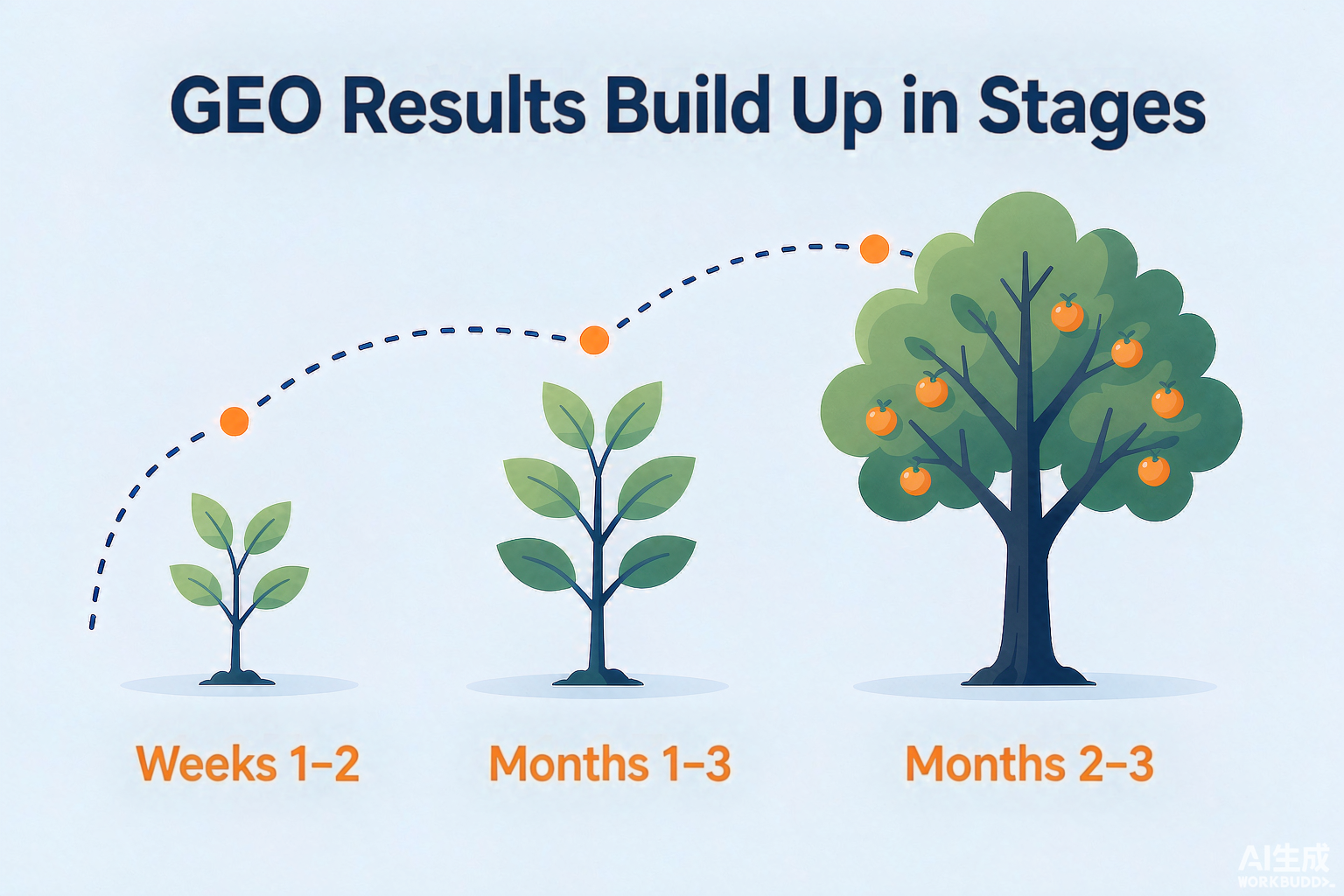
Reference cycles for three stages (from our delivery observations; varies by industry and content base):
- Getting crawled: once the site moves to static rendering, crawler activity usually changes visibly within 1–2 weeks.
- Getting cited: stable citations generally start within 1–3 months; high-weight sources such as encyclopedias and Zhihu tend to take effect faster.
- Getting leads: depends on the industry's decision chain; in education and home renovation, clear inbound leads appear within 2–3 months.
Run it in 90 days: month one — technical foundation, unified brand voice, encyclopedia entries; month two — case pages and long-tail Q&A, laying sources across Zhihu and media; month three — monthly monitoring in place, iterating content based on check results. One education client of ours ran the "full-platform AI keyword coverage + traditional search" dual-channel play and reached an ROI of 1:20, with 40+ direct closed deals and a 30% lead conversion rate (data represents that project only).
Practices That Actually Hurt
- Touching only the website and not the brand side: no matter how good your site is, when third-party sources are missing, AI answers about your brand lean on competitors and stale information — the most common way to quit halfway.
- Keyword stuffing: research shows stuffing lowers AI visibility; models want fact density, not word frequency.
- Stuffing the FAQ block with fifty generic questions: piles of low-quality FAQPage markup can be down-weighted; five real questions beat fifty fillers.
- Publishing raw AI-generated content: homogeneous, unedited AI content keeps getting cited less; human experience and judgment must go in.
- Believing "top of AI answers in three days" promises: the way AI answering works means no one can guarantee a recommendation slot — whoever promises one has a problem.
- Treating GEO as an SEO replacement: it is an addition, not a substitute — traditional search rankings and AI-channel citations are two incremental lines.
Frequently Asked Questions
Do GEO and SEO require choosing one over the other?
No. They share most of the technical base (crawlable, well-structured, trustworthy), and GEO is a layer added on top of healthy SEO so content gets further cited by AI.
My website ranks well in SEO — why does AI still recommend competitors?
Most likely the brand-side sources are missing: no encyclopedia entry or a stale one, no substantive brand answers on Zhihu, nothing recent findable in the media. AI cross-checks third-party sources when answering brand questions, and website rankings cannot help there. Start with entity consistency and the encyclopedia entry.
How long until results show?
Technical changes show crawler effects within 1–2 weeks; stable citations generally start in 1–3 months; the brand-side encyclopedia and Zhihu layout usually lands faster than website content. The shorter the promised timeline, the more suspicious you should be.
Can I do GEO without real cases and data?
Build the material first. GEO is not copywriting packaging — a fabricated number, even if cited once, costs far more when exposed than it ever earned. Content must be true for the method to work.
How do I know whether AI mentions my brand — and says it correctly?
Use the monthly check method: a fixed question list, category and brand questions tested separately, run platform by platform, tracking mention rate and accuracy trends. Half an hour of manual checking gives more realistic insight than many paid tools' first-month reports.
The essence of GEO is writing your brand's real capabilities, cases, and data in a form machines can read and models are willing to cite, with one consistent voice across your website and off-site sources. Content must be true for the method to work. To find out what AI currently says about your brand, book GongBan AI's free enterprise AI diagnosis.
Further Reading
- What is GEO? The New Customer Acquisition Entry in the AI Search Era
- Case Study: Full-Platform AI Keyword Coverage for a Postgraduate Exam Coaching Business
References
- China Internet Network Information Center (CNNIC), "Generative AI Application Development Report (2025)", 2025-10-18, https://www.cnnic.net.cn/n4/2025/1021/c88-11391.html
- GongBan AI case: Rongshang Civil-Service Exam Coaching - full-platform AI keyword coverage, https://www.gongbanai.com/en/case/rongshang.html (data represents that project only)
- Methodology references: GEO content structure (inverted pyramid + modular Q&A), three data elements, source cross-validation, and monthly spot-check method, compiled from public articles by multiple GEO service providers and marketing media, 2025-2026; no industry data from those providers is cited in this article